Power is one of the most discussed and searched-for topics in modern tennis. Everyone wonders: how to do power shots in tennis? what is the secret to hitting a power serve? are there specific exercises to generate more power on the forehand or the backhand? In an era where the strokes of champions like Jannik Sinner, Carlos Alcaraz, or Novak Djokovic are analyzed down to the millimeter, curiosity keeps growing: how do tennis players generate so much power? what is the average speed of a forehand or backhand on the ATP Tour? and is it true that Aryna Sabalenka can serve faster than many male players?
In this article we will answer these questions starting from real data — average shot speeds, differences between surfaces, the actual impact of a tennis ball at 200 km/h — and then moving to practical advice on how to gain more power in tennis, whether through technique and physical conditioning, or through the right equipment choices and advanced technologies.
Whether you are a club player looking to add more energy to your shots, or simply a tennis fan curious about the science behind explosive strokes, you will find here a complete, structured guide. In the end, we will also discuss an innovative tennis accessory that uses advanced design and materials to enhance both power and comfort on court.
Are you looking to improve your shot power?
Check out our new Auxetic Power Pads –increase power without losing control!
1. What Does “Power” Mean in Tennis: Physics, Energy, and Dynamics
When we talk about power in tennis, we don’t just mean “hitting harder”. Power means maximizing the useful energy of a shot while minimizing losses such as friction, vibration, or inefficiencies. In physics, power is defined as work over time, but in tennis it is more useful to think of it as the transfer of energy from the racket to the ball, with the player’s kinetic chain (legs, core, arm) acting as the transmitter.
Energy transfer: impact and restitution
Not all of this energy arrives: part is dissipated in elastic deformation, vibrations, and heat. This is the margin that well-designed equipment can optimize to help a player generate more power in tennis.
In controlled experiments, researchers study how much of the ball’s “bounce speed” is proportional to racket head speed plus the incoming speed of the ball before impact (when there is a rebound effect).
Force, mass, and acceleration: the kinetic chain
According to the formula F = m × a, the force generated depends on how much acceleration you can create with the moving parts — racket, arm, and body.
By working with the kinetic chain, a player “pre-loads” the legs and core to transfer energy in sequence into the shot.
The acceleration of the racket at the exact moment of contact is crucial: the faster you can move it in that brief instant, the more energy you can transfer to the ball.
Vibrations and energy loss: the post-impact skyscraper
After impact, the racket continues to vibrate. These oscillations don’t add speed to the ball; they represent wasted energy and mechanical “noise.”
Good equipment design — in terms of materials, racket construction, or vibration dampening accessories — can reduce these losses without interfering with the energy transfer that powers the shot. In other words, it damps what is left over, not what makes the ball travel fast.
This is exactly where innovative solutions can make a difference: filtering and moderating harmful frequencies while preserving power.
Frame dynamics and the role of stiffness
A tennis frame has a certain elastic flexibility: when the ball deforms it slightly, the frame pushes back, contributing to the restitution of energy.
If the frame is too stiff or too flexible, the balance between deformation and restitution can be suboptimal.
Some studies even analyze how parameters such as moment of inertia and principal moments affect the dynamics of impact in tennis.
2. Technique: How Physics Translates Into Tennis Power
If in the previous section we looked at the physics of tennis and how energy is transferred from the racket to the ball, the next question is inevitable: how does all this translate into actual tennis play?
The answer lies in technique. Having muscular strength or a high-performance racket is not enough: power in tennis comes from the ability to use the kinetic chain, the progressive transfer of energy from the legs, core, and trunk through the arm, forearm, and finally the wrist. It is a sequence of coordinated movements, not a single isolated action.
The role of the legs and core
The core (abdominals and lower back muscles) acts as an “energy bridge,” transferring the force of the push toward the upper body.
This is why professional players always show strong trunk rotation and a coordinated use of the lower chain when producing powerful shots.
Timing and the contact point
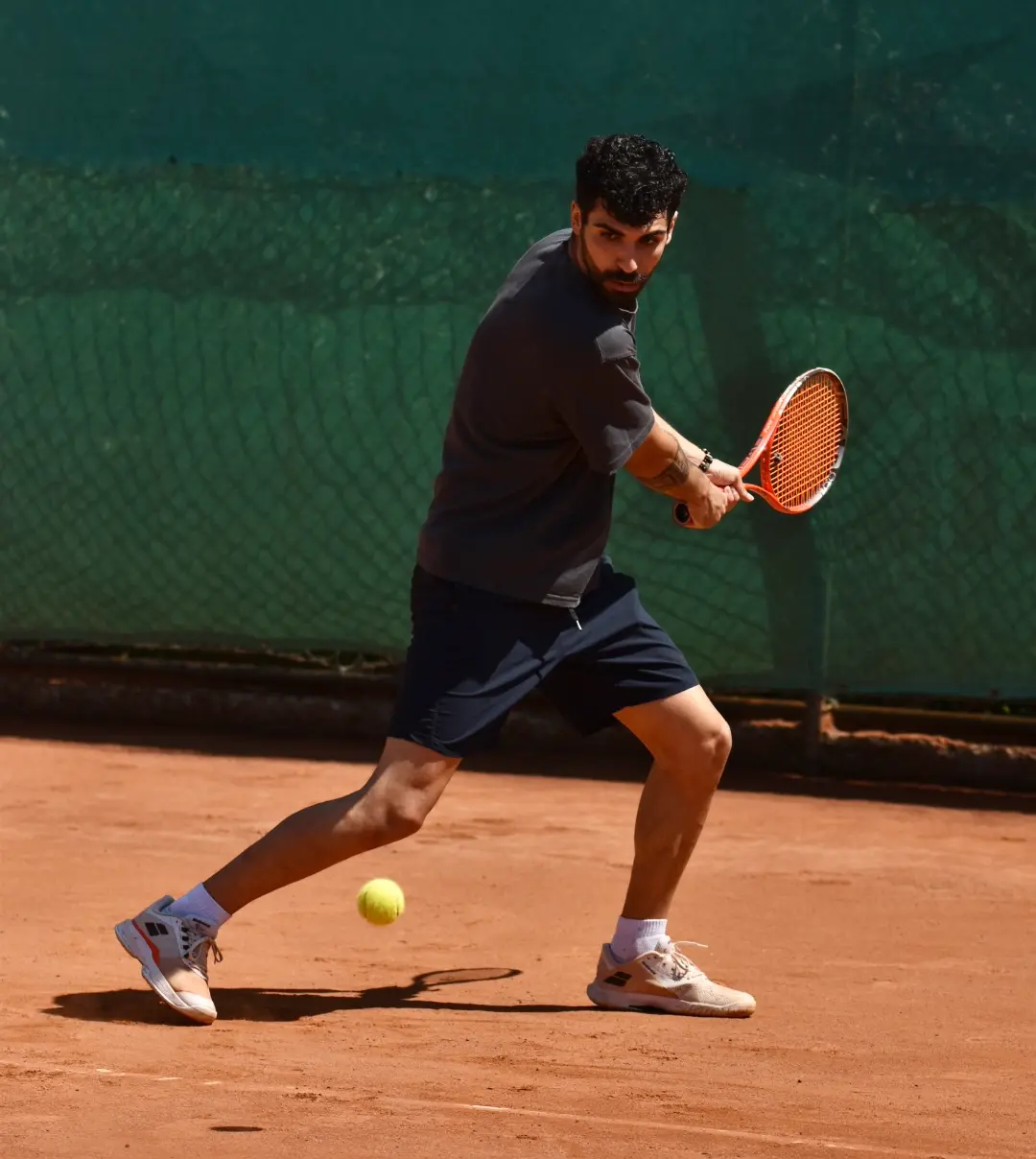
To generate power on the forehand it is not enough to swing hard: you must hit at the right moment.
The ideal contact point is in front of the body: hitting late reduces leverage and racket head speed.
This is where specific footwork and timing drills become essential for players who want to learn how to do power shots in tennis without losing control.
Rotation and topspin: the pro secret
Topspin is not only about control, but also an ally of power: it allows players to hit harder while keeping the ball in the court thanks to the Magnus effect.
This is why modern tennis is often described as a game of rotations: topspin provides margin and confidence, letting players swing freely without fear of hitting long.
Differences between strokes: serve, forehand, backhand
Every stroke has its own “power model”:
A power serve in tennis is built from the ground up: strong legs, upward thrust, jump, extension, and the whip-like action of the arm.
- A powerful forehand relies on trunk rotation and the release of the arm in front of the body.
- A backhand with power requires even more precise timing, because the leverage is shorter (especially in the one-handed version).
This explains why the average speeds of serve, forehand, and backhand differ so much on the ATP Tour. (We will return to this point in the section dedicated to professional players, with a focus on Sinner, Alcaraz, and Djokovic).
3. Physical Conditioning to Increase Power in Tennis
If technique and timing are essential, it is equally true that without a solid physical foundation it is difficult to generate powerful shots. Power in tennis comes from strength, explosiveness, mobility, and endurance. This is why it is important to know which muscles to strengthen for tennis and which exercises provide direct benefits on court.
The key muscles for power
- Legs: quadriceps, glutes, and calves provide stability and push in groundstrokes and the serve.
- Core: abdominals and lower back transfer energy between the lower and upper body.
- Shoulders and lats: essential for racket head speed and for preventing injuries.
- Forearms and wrist: allow players to control the racket in the final phase of impact.
Exercises to hit harder in tennis
Strength exercises
- Squats and lunges → build stronger legs and glutes, improving push-off from the ground.
- Plank and side plank → strengthen the core, indispensable for trunk rotation.
- Pull-ups or lat pulldown → develop the lats, improving racket acceleration.

Plyometric exercises (explosiveness)
- Box jumps → increase lower-body power and reactivity.
- Medicine ball throws (against a wall or with a partner) → simulate the explosive motion of tennis strokes.
- Burpees and short sprints → train speed and reactivity, crucial for hitting hard in match situations.
👉 What is plyometric training? → It is a training method based on explosive, rapid movements that alternate a loading phase (muscle stretch) with an immediate push-off (contraction). It is widely used by athletes in many sports to improve power and speed.
Mobility exercises
- Dynamic stretching for hips and shoulders → increases range of motion.
- Rotations with a stick or elastic band → improve the fluidity of the kinetic chain.
👉 Which exercises help you gain more power in tennis? → Squats, planks, medicine ball throws, and box jumps are among the most effective drills to improve shot power.
Functional training for tennis
It’s not just about training single muscles, but about reproducing movements that imitate tennis gestures: rotations, jumps, sudden stops. Functional training improves not only strength, but also the ability to transform it into explosive strokes on court.
In reality, the mental component counts just as much as the physical one: the confidence to “let the arm go” also comes from the ability to break patterns and strategies. We explored this idea further in Breaking the Rhythm: Unconventional Strategies and the Mind in Tennis.
Video and recommended resources
At AMbelievable™ we believe that true improvement requires two elements: the athlete’s sacrifice and listening to the advice of a good coach.
That’s why we suggest watching this video by one of the most influential tennis coaches of the past 20 years, Patrick Mouratoglou:
🎥 4 secrets to develop your power | TENNIS MASTERCLASS
YouTube can be a useful tool for learning in many fields, including tennis. However, following online advice alone is not enough to make a real leap in quality: our suggestion is always to work with a coach who can follow you closely during training.
4. Tennis Surfaces and Power
The speed of tennis shots depends not only on the player or the racket, but also on the type of surface. Many players and fans often ask: “Which surface is fastest in tennis?” or “What is the slowest tennis surface?”. It’s a key question, because the court directly influences perceived power and the effectiveness of every shot.
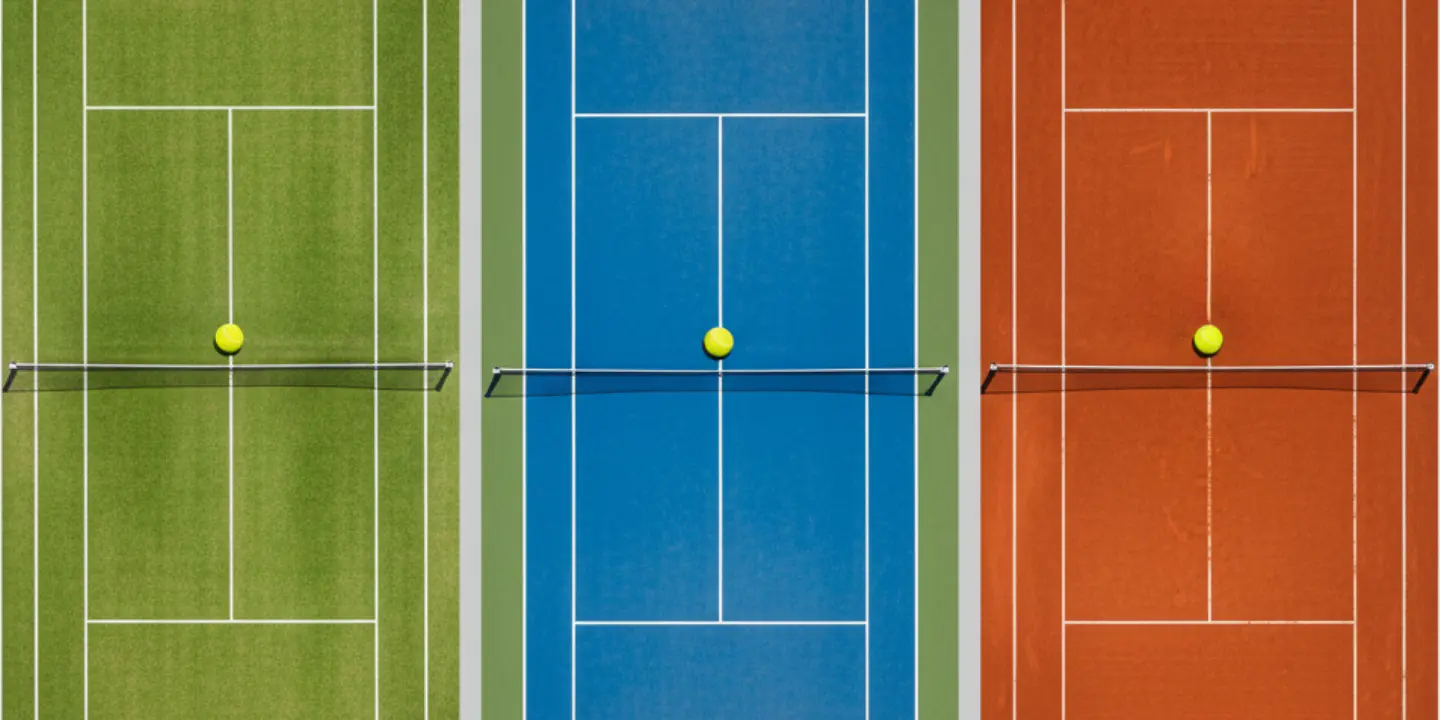
Grass: the fastest surface
Grass has always been considered the quickest surface.
The ball tends to skid, bounce low, and maintain much of its initial speed.
This makes grass perfect for power serves and fast rallies: no coincidence that Wimbledon has always been the temple of the big hitters.
Hard courts: the “standard” (but slower today)
Over the years, hard courts have been made slower on the ATP and WTA tours, in order to extend rallies and reduce the number of “serve-and-finish” points.
Today, hard courts provide a compromise: still fast enough to reward the serve, but with higher bounces that allow for longer exchanges.
This means that hitting powerful shots on modern hard courts requires more effort than it did in the past.
Clay: the slowest surface
Clay is synonymous with long, demanding rallies.
The ball bounces high, loses speed, and gives the opponent more time to react.
To finish points on clay, players need not only more power but also more topspin to push the ball through the court.
Not surprisingly, players like Nadal have built their dominance on the ability to hit hard and with heavy spin on clay.
👉 If you want to dive deeper into how friction on different courts affects ball bounce and speed, check out our dedicated article: The Role of Friction on Court Surfaces: How Different Courts Shape the Game.
📌 In summary
- Which surface is fastest in tennis? → Grass is the fastest: the ball skids and bounces low, keeping much of its speed.
- What is the slowest tennis surface? → Clay is the slowest: the ball bounces higher and slows down, making rallies longer.
- And hard courts? → Today they are an intermediate surface, deliberately slowed down in ATP tournaments compared to the past.
5. How Hard Do Professional Tennis Players Hit?
When it comes to power in tennis, fans immediately turn their curiosity to the professionals: who is the hardest hitter in tennis? What is the average forehand and backhand speed on the ATP Tour?
The truth is that the numbers are impressive: forehands often exceed 130 km/h, and serves regularly go beyond 200 km/h. Let’s take a closer look at the data from some of the most notable players.
The serve: the most immediate source of power
- ATP average: between 190 and 210 km/h for the top servers.
- Jannik Sinner: his flat serve regularly reaches 210–215 km/h.
- Carlos Alcaraz: less of a “cannon” compared to Sinner, but still stable around 200 km/h.
- Novak Djokovic: less explosive but extremely precise, with an average speed of ~195 km/h.
- Aryna Sabalenka (WTA): her serve can exceed 200 km/h, faster than many male colleagues.
This has intrigued and sparked debate among fans — to the point that on social media some even imagined a showdown with Nick Kyrgios, a contemporary remake of the famous Battle of the Sexes, when Billie Jean King defeated Bobby Riggs in 1973.
👉 How fast can Sabalenka serve? → Aryna Sabalenka can serve over 200 km/h, faster than several players on the men’s tour.
The forehand: the symbol of modern power
- ATP average: 120–130 km/h.
- Jannik Sinner: one of the fastest forehands on tour, with peaks up to 135–140 km/h.
- Carlos Alcaraz: slightly less linear but very explosive, with similar speeds to Sinner.
- Novak Djokovic: fewer extreme peaks, but a consistent forehand around 125–130 km/h.
👉 What is the average forehand speed in tennis? → The average forehand speed on the ATP Tour is about 120–130 km/h, with peaks above 135 km/h for players like Jannik Sinner.
The backhand: precision and timing
- ATP average speed: 105–115 km/h.
- Jannik Sinner: his two-handed backhand is extremely penetrating, reaching up to 120 km/h (one of the fastest on tour).
- Carlos Alcaraz: very solid but less explosive, averaging around ~110 km/h.
- Novak Djokovic: the most consistent backhand on the tour, stable between 110–115 km/h.
👉 How fast is Sinner’s backhand? → Jannik Sinner’s backhand can exceed 115–120 km/h, making it one of the fastest on the ATP Tour.
👉 How fast is Carlos Alcaraz’s backhand? → Alcaraz averages around 110 km/h, slightly below Sinner’s peaks.
👉 Who has the fastest backhands on the ATP Tour? → Sinner is among the top, with backhand speeds reaching 120 km/h.
📌 In summary
- Who is the hardest hitter in tennis?
- On serve: historic record holders like Karlovic or Isner have surpassed 230 km/h, but today Sinner is among the fastest with over 215 km/h.
- On the forehand: Sinner and Alcaraz can reach 135–140 km/h.
- On the backhand: Sinner is again among the fastest, with peaks at 120 km/h.
- On the women’s tour: Aryna Sabalenka is known for her serve above 200 km/h.
- On serve: historic record holders like Karlovic or Isner have surpassed 230 km/h, but today Sinner is among the fastest with over 215 km/h.
6. Equipment and Power: Rackets, Strings, and Accessories
To answer one of the most common questions — “How to get more power from a tennis racket?” — you need to consider several factors. It’s not enough to pick any model: you must analyze the racket’s specifications, the strings, and the accessories that directly influence ball speed and overall feel.
Racket: weight, balance, and stiffness
- Head size: a larger string bed (100–110 in²) offers a stronger trampoline effect and therefore more power.
- Weight: lighter rackets (260–290 g) allow faster swing speed, while heavier ones (300–330 g) provide more stability at impact.
- Balance: a head-heavy racket helps generate more power but may tire the arm; a head-light racket improves maneuverability but adds less raw force.
- Stiffness: a stiffer frame returns more energy to the ball, but may be less comfortable on the joints.
👉 Which racket gives more power in tennis? → A racket with a larger head size, medium-to-high stiffness, and head-heavy balance increases power, while lighter frames make it easier to accelerate the swing.
Strings: tension and materials
This brings us to another crucial question: “How to get more power with tennis strings?”
Tension:
- Tighter strings (25–27 kg) provide control but less power;
- Looser strings (20–23 kg) return more power thanks to a greater trampoline effect.
Materials:
- Multifilament → more elasticity and comfort, ideal for generating extra power.
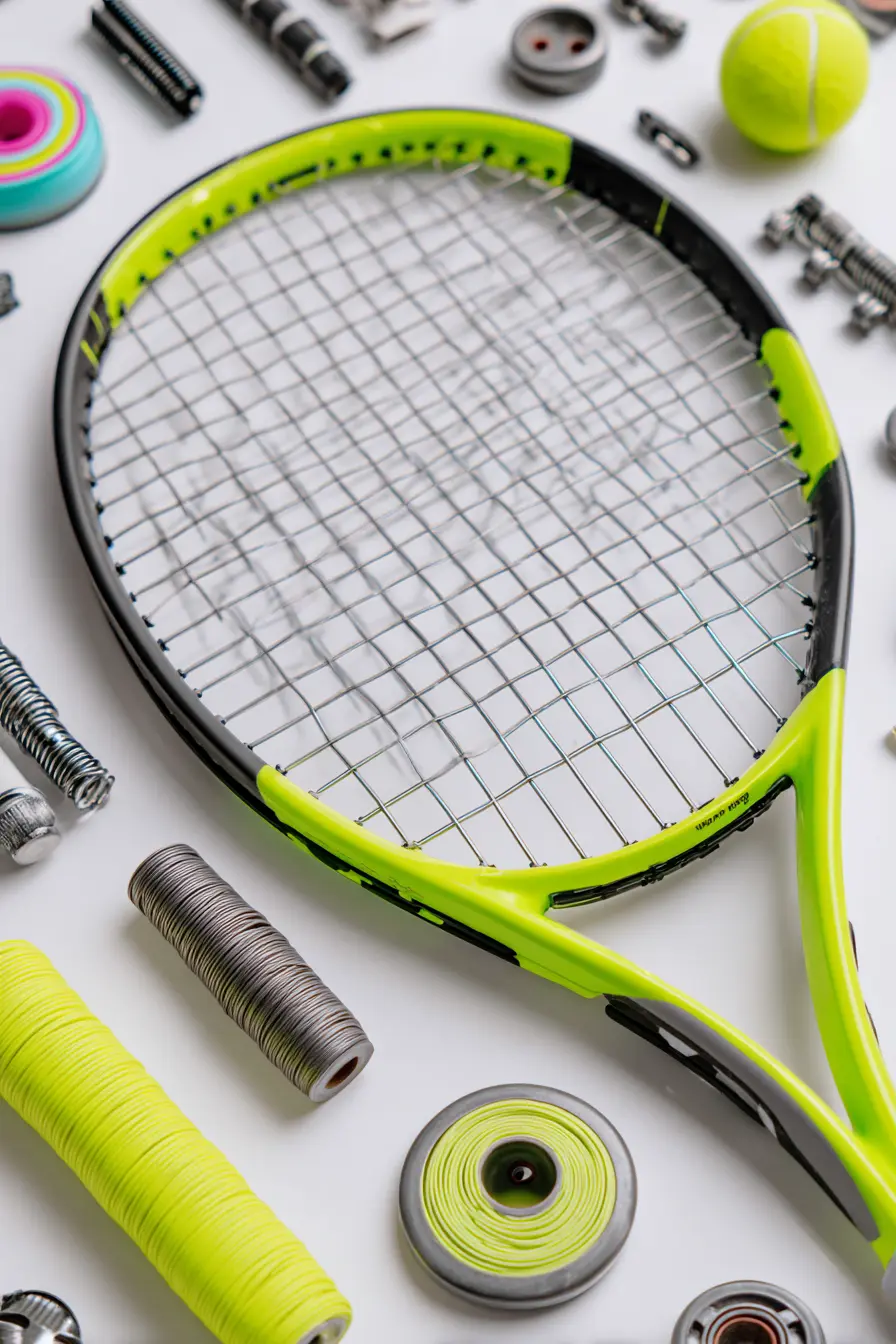
- Monofilament (polyester) → more control and durability, but less energy return.
Accessories: from grips to dampeners
Beyond rackets and strings, accessories also play a significant role.
- Grip and overgrip: improve grip security, preventing energy loss from slipping hands.
- Vibration dampeners: often debated, but a dampener does not reduce power. It acts on the vibrations that occur after impact, improving comfort and stability.
Our innovation
While many traditional dampeners attempt to “block” all vibrations indiscriminately — sometimes dulling useful sensations — our products are designed with patented 3D-printed structures that filter frequencies selectively, including those from the frame that are often overlooked.
The result is a cleaner impact, better arm protection, and most importantly, the ability to hit with greater confidence — and therefore with more real power.
👉 Does a vibration dampener reduce power in tennis? → No. Moreover, AMbelievable™ dampeners do not take energy away from the ball; by improving stability and confidence at impact, they help you channel your full power more effectively.
7. Innovative Tennis Accessories: How to Increase Racket Power with AMbelievable™ Auxetic Pads
In recent years, innovation in materials has revolutionized tennis: we have often talked about metamaterials, and today we introduce a concrete result that this technology makes possible — the use of auxetic structures in sports equipment.
An auxetic structure is a material with a negative Poisson’s ratio, meaning that under pressure it expands laterally instead of contracting, thanks to its internal geometry. This unique behavior allows the material to absorb energy more efficiently and to modulate residual vibrations.
The added value of our Auxetic Pads
Thanks to this technology, the AMbelievable™ Auxetic Pads deliver a sophisticated and targeted action:
- At the moment of impact, their structure densifies, supporting the strings more effectively and returning energy to the shot.
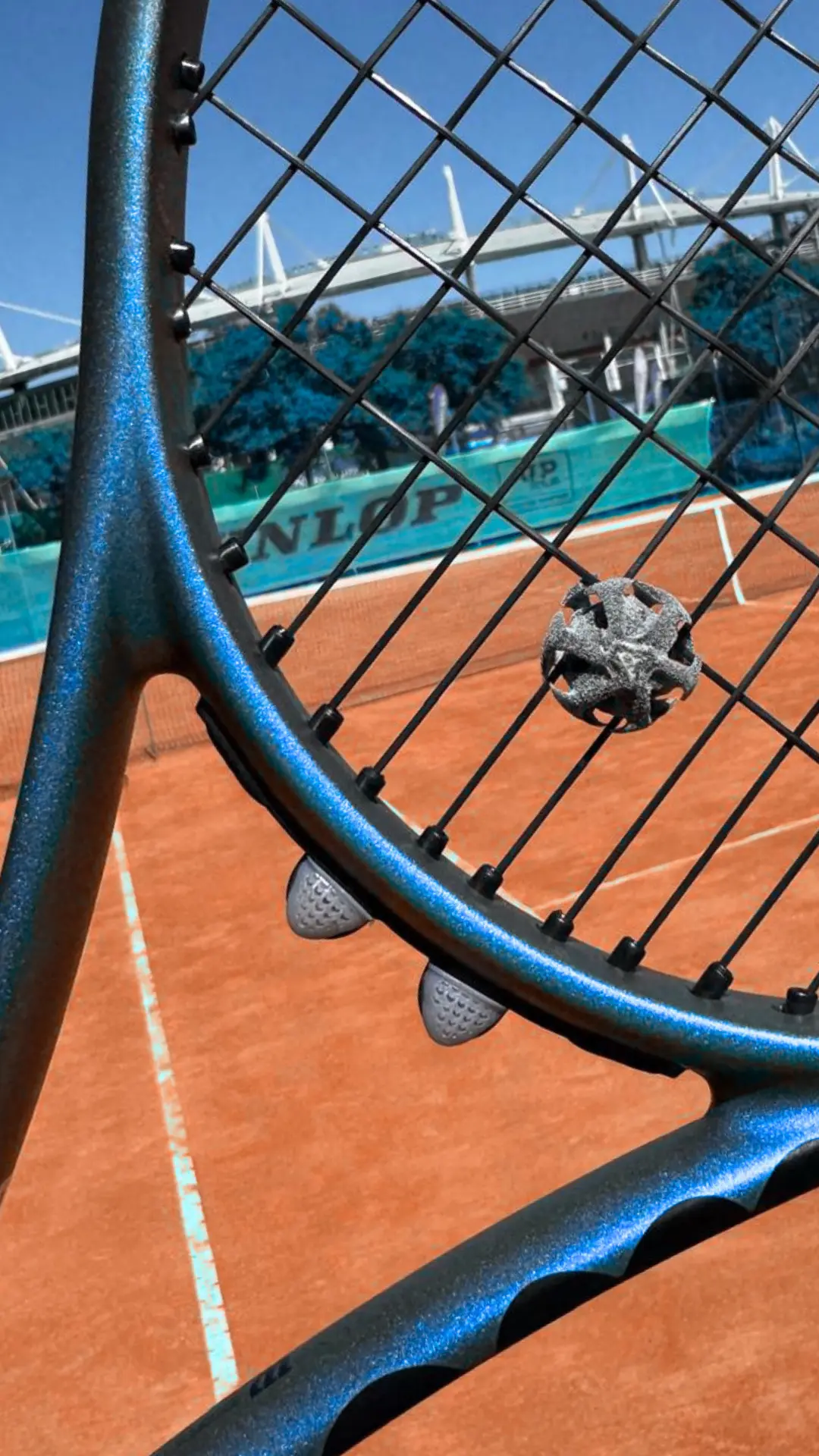
- In the following phases, they filter out unwanted frequencies, damping vibrations that do not contribute to the shot but fatigue the arm.
The result? More explosive strokes, greater stability at contact, and protection for arm comfort and overall feel.
So if you want to gain more power in tennis without losing control, try the Auxetic Pads: innovative tennis accessories designed to boost power, stability, and comfort in every rally.
8. Practical Exercises to Increase Power in Tennis
In Section 3 we looked at which muscles to strengthen and which physical principles to train in order to generate more power.
Now we move to a different level: practical drills and exercises, both on court and in the gym, that you can integrate immediately into your training to make your shots more explosive.
If theory and technology explain why some players manage to hit so hard, daily practice answers the most common question: “How to do power shots in tennis?”.
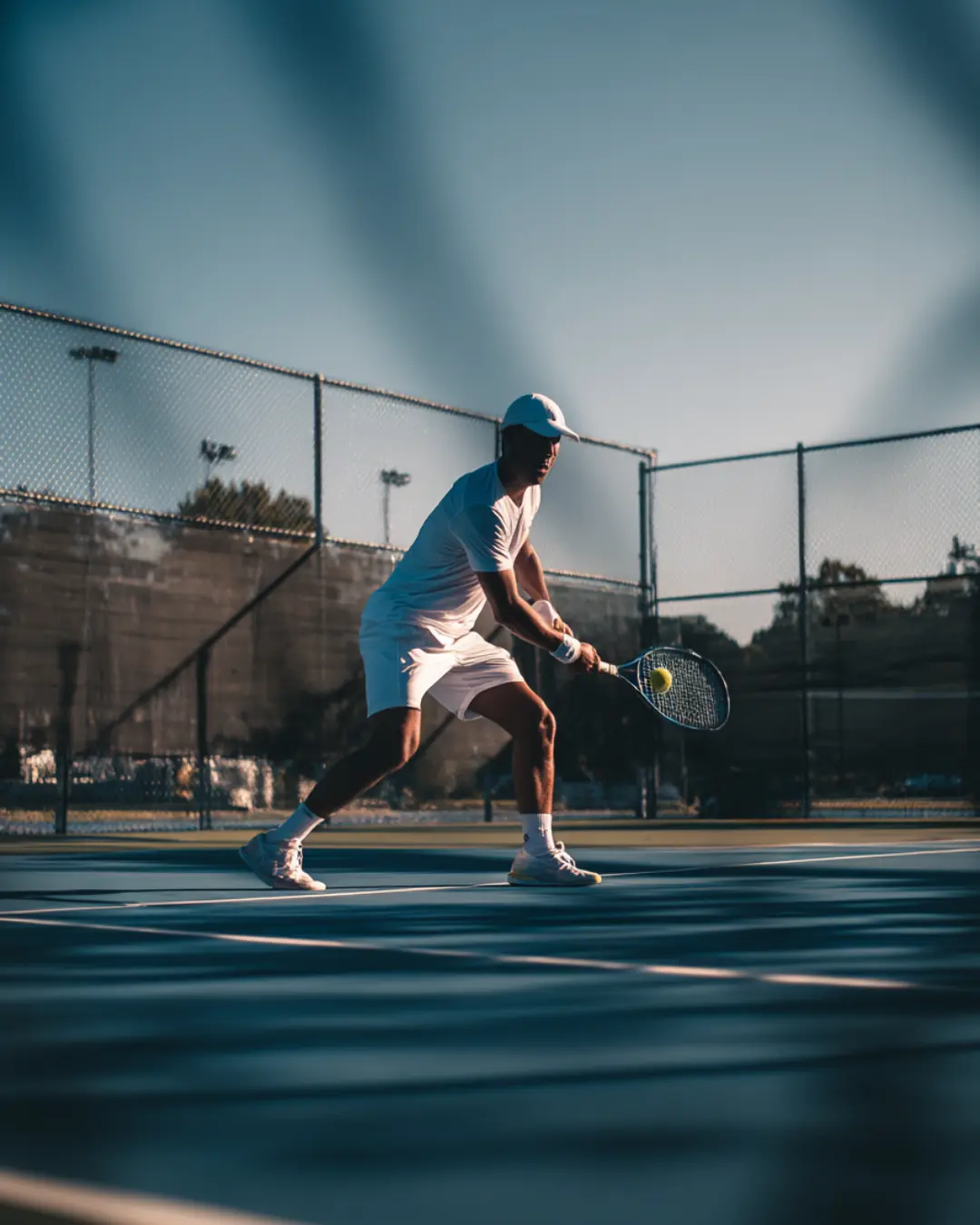
It’s not enough to know the technique: you need targeted tennis exercises that train power, coordination, and confidence in your movements.
On-court drills
- Shadow swings with trunk rotation
Practice without the ball, focusing on the movement of the kinetic chain: legs → core → arm. The smoother the sequence, the more power you generate. - Progressive serve exercise
Start serving at 50% intensity and gradually increase to 100% while maintaining control. This helps you find the right timing for a power serve in tennis without stiffening up. - Rally with increasing intensity
Rally with a partner, increasing ball speed every 10 shots. Improves your ability to hit harder under real match conditions.
Off-court drills
- Medicine ball throws
Simulate the explosive motion of a tennis stroke, building strength and rotation. Perform both frontally and laterally. - Plyometric jumps (box jumps or squat jumps)
Increase leg explosiveness, essential for both the forehand and the serve. - Elastic band rotations
Reproduce trunk movement during forehand and backhand, strengthening the core in a functional way.
👉 In short: squats, planks, plyometric jumps, and medicine ball throws are among the most effective exercises to gain more power in tennis shots.
Suggested routine
A simple weekly program for a club player could include:
- 2 strength sessions (squats, planks, pull-ups).
- 2 explosiveness sessions (plyometrics + medicine ball).
- 1–2 on-court sessions with technical drills (progressive serves, high-intensity rallies).
With consistency, these exercises will improve not only your power, but also your stability, while reducing the risk of injury.
📌 Final note: when training with these exercises, remember that power doesn’t come from muscles alone — it also comes from confidence in your stroke. Feeling stable and protected — even thanks to the right accessories — is what allows you to really let your arm go.
9. Conclusion: The Formula for Power in Tennis
Increasing power in tennis does not simply mean hitting harder: it is the result of multiple factors working in harmony.
On top of that comes equipment: rackets, strings, and accessories that can make a real difference.
The latest technologies — such as auxetic metamaterials — open new possibilities, making it possible to boost shots without sacrificing control.

This is exactly where our AMbelievable™ Auxetic Pads come in: innovative tennis accessories designed to filter harmful vibrations and return more useful energy to the ball. The result is a more powerful, stable, and enjoyable game, accessible to every player.
🎾 So if you want to gain more power in tennis and experience the difference of a truly innovative approach, discover our Auxetic Pads: the simplest way to make every rally more explosive and under control.