
As temperatures drop and the days get shorter, tennis moves indoors. With the 2026 Nitto ATP Finals bringing the world's best players to Turin from November 15 to 22, indoor tennis is once again taking center stage.
But moving under a roof involves more than escaping the winter weather.
Have you ever noticed that your racket seems to feel different indoors? Perhaps the ball sounds louder, your strings feel stiffer, or your shots seem to respond differently, even though you're using exactly the same equipment.
There's some fascinating physics behind these sensations. Temperature can influence the behavior of tennis balls and strings, while the acoustics of an enclosed court can change how we hear each impact. And here's where things get particularly interesting: the sound of a shot can influence how we perceive it.
Let's explore what really changes when tennis moves indoors, how these factors interact, and what they mean for your racket setup.
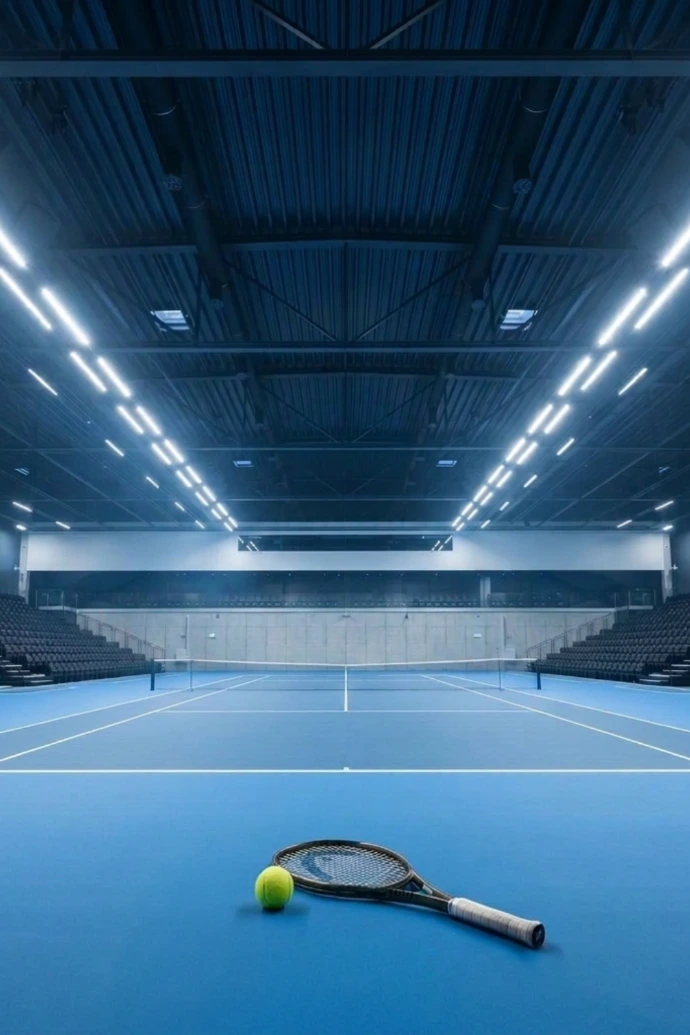
1. Indoor vs. Outdoor Tennis: What Really Changes?
At first glance, the biggest difference between indoor and outdoor tennis seems obvious: no wind, no rain, and no sun interfering with your shots. With fewer environmental variables, indoor courts can offer more consistent playing conditions.
But that's only part of the story.
Indoor tennis isn't a single set of playing conditions. A professional tournament inside a climate-controlled arena and a match at your local tennis club in December can offer very different experiences.
Consider three important factors:
Temperature: Indoor courts aren't necessarily warmer than outdoor ones. While major arenas typically maintain controlled conditions, smaller indoor facilities can experience significant temperature variations, particularly during winter. These changes can influence the response of tennis balls and string materials.
Playing surface: Indoor tennis can be played on hard courts, carpet or other surfaces. Court construction, surface friction and ball characteristics all contribute to the speed and bounce experienced by players. That's why an indoor court isn't automatically faster than an outdoor one.
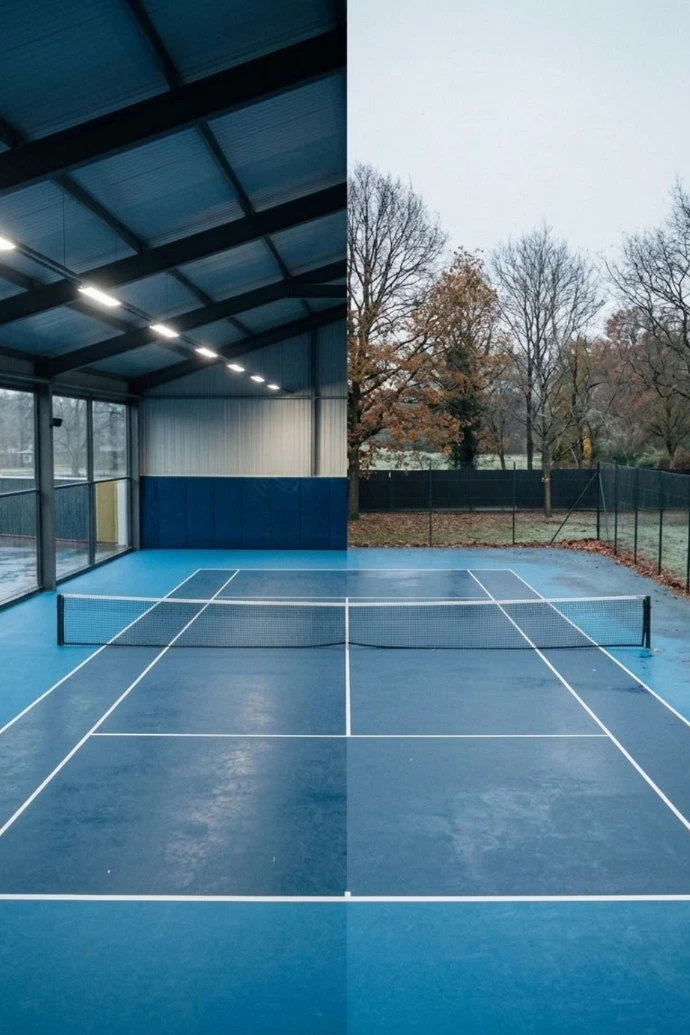
Acoustics: Outdoors, sound can propagate away from the court with relatively few reflections. Indoors, walls, ceilings and other surfaces reflect sound waves, potentially making racket impacts seem louder, sharper or more resonant, depending on the venue.
These differences matter because tennis is a sport of extremely precise sensory feedback. With every shot, your brain combines visual information, the sound of the ball and the mechanical sensations transmitted through your racket to interpret the quality of the impact.
Change the environment, and some of those signals can change too.
So, if your usual racket suddenly feels unfamiliar when the indoor season begins, the explanation might not lie in your technique or equipment alone. It could also have something to do with the conditions surrounding every shot.
And one of the first things worth investigating is how lower temperatures affect two essential components of your setup: the ball and the strings.
2. How Cold Affects Tennis Balls and Strings
Have you ever stepped onto a cold indoor court and felt like you suddenly had to work harder to generate the same power?
You're not necessarily imagining it. Temperature can influence how a tennis ball rebounds and how your strings respond to impact. And understanding why means looking at two different physical phenomena.
The Tennis Ball: A Matter of Pressure and Elasticity
A pressurized tennis ball contains gas that helps it maintain its shape and rebound after impact. As temperature decreases, the pressure of that gas decreases too, provided the ball's volume remains approximately constant.
This relationship is described by Gay-Lussac's law, which states that the pressure of a gas is proportional to its absolute temperature when volume is constant.
But internal pressure is only part of the story. The rubber shell also contributes to the ball's elasticity and energy return.
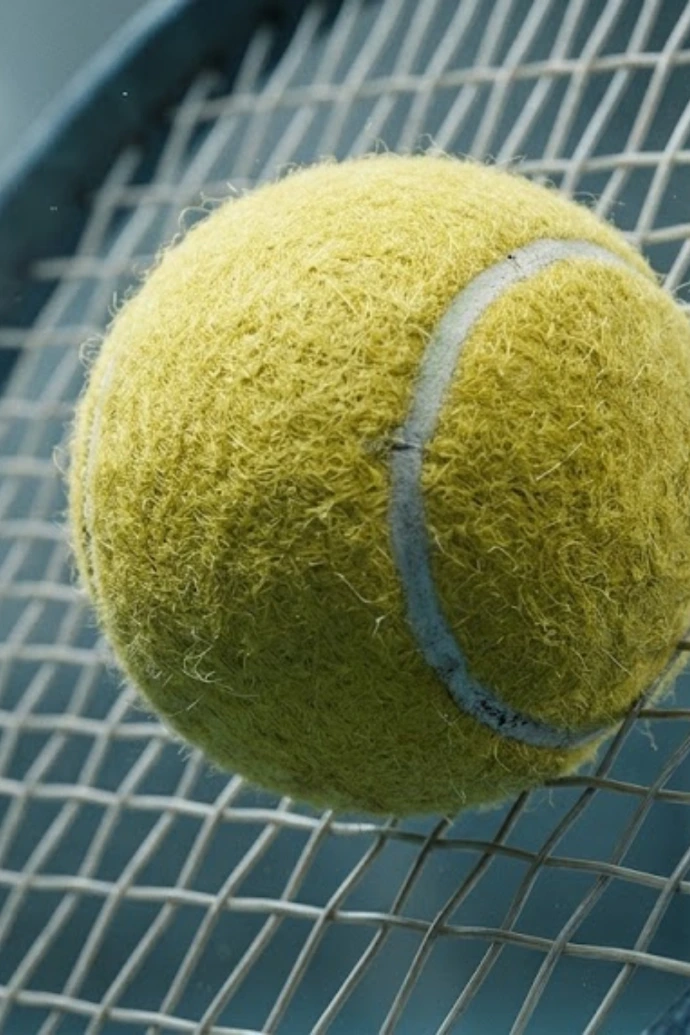
At lower temperatures, changes in the ball's internal pressure and material properties can influence its coefficient of restitution: the ratio between the speed after a collision and the speed before it.
In practical terms, a cold tennis ball may bounce lower and feel less lively than the same ball at a warmer temperature.
This is especially relevant when balls have been stored in an unheated environment before a match. Even if the court itself is relatively warm, the balls may initially behave differently until their temperature adjusts.
The Strings: Why Temperature Changes Racket Feel
Strings are also sensitive to temperature, although the relationship is more complicated than simply saying that cold increases tension.
A study by Crawford Lindsey and Rod Cross, published by Tennis Warehouse University, investigated how temperature affects tennis string tension, elongation and stiffness.
The researchers tested different string materials, including polyester, nylon and natural gut, and found that lower temperatures generally increased string stiffness, while higher temperatures tended to make strings more compliant.
An important distinction is that string tension and string stiffness are not interchangeable.
Tension describes the pulling force acting on a string, while stiffness describes how strongly that string resists deformation. Two strings with the same tension can respond quite differently to the same impact.
And that's what matters to the player.
When a stringbed becomes less compliant, the impact may feel firmer, even if the racket and its original stringing tension haven't changed.
Different materials also react differently to temperature. In the Tennis Warehouse University experiments, nylon strings generally showed greater temperature sensitivity in stiffness than polyester strings, although individual string models varied.
So, should you lower your string tension during winter?
Not automatically. If you regularly play in colder conditions and notice a consistently firmer response, a small adjustment might be worth discussing with your stringer. But your string material, playing preferences and actual court temperature should guide that decision.
For a deeper look at how string materials and tension interact, explore our article on the physics of tennis strings and racket setup.
Of course, temperature isn't the only thing that changes when tennis moves indoors. There's another variable that players experience with every single shot, often without consciously noticing it: sound.
3. Why Does Tennis Sound Different Indoors?
Think about the distinctive pop of a perfectly struck tennis ball.
Outdoors, that sound travels away from the racket, gradually losing intensity as it spreads through the surrounding environment.
Indoors, something different happens.
When the ball meets the strings, the impact generates mechanical vibrations in the racket and sound waves that travel through the air. Inside an enclosed court, those sound waves encounter walls, ceilings and other surfaces, which can reflect part of their energy back toward the player.
The result? The same shot can sound noticeably different depending on where you're playing.
The Physics of Reverberation
One of the key concepts here is reverberation: the persistence of sound caused by multiple reflections within an enclosed space.
Unlike a distinct echo, which can be heard as a separate repetition, reverberation creates a series of overlapping reflections that extend the perceived duration of a sound.
A study published in the scientific journal Applied Acoustics, titled The Influence of Profiled Ceilings on Sports Hall Acoustics, examined how the geometry and materials of indoor sports halls affect sound absorption and reverberation.
The research highlights an important point: the acoustic behavior of a sports hall depends not only on its size, but also on the shape and sound-absorbing properties of its surfaces.

This helps explain why the impact of a tennis ball can sound sharp and dry on one indoor court, but louder or more resonant on another.
A large arena with carefully designed acoustic treatment may behave very differently from a smaller covered court with hard, reflective walls.
Does a Louder Impact Mean a More Powerful Shot?
Not necessarily.
The sound produced by a racket-ball collision depends on several factors, including impact characteristics, stringbed properties and racket vibrations. But the sound you actually hear also depends on how the surrounding environment modifies those acoustic signals.
Consequently, a louder or sharper impact doesn't automatically indicate that you're hitting the ball harder.
Two shots with similar mechanical characteristics can produce different auditory experiences when played in different acoustic environments.
And this introduces a particularly interesting question.
If the same impact can sound different depending on the court, could that difference in sound also influence how the racket feels in your hand?
To answer that, we need to explore something even more fascinating than the physics of the racket itself: how the human brain combines sound and touch to interpret a tennis shot.
4. Can Sound Change How Your Racket Feels?
We've established that the same tennis shot can sound different depending on the surrounding environment. But here's where things get even more interesting: sound doesn't just tell us what happened. It can also influence what we think happened.
Our brains don't process sound, touch and vision as completely separate experiences. Instead, they combine information from different senses to build a coherent interpretation of the world around us.
In neuroscience, this process is known as multisensory integration.
And tennis provides a fascinating example of how it works.
Your Brain Doesn't Just Watch the Ball. It Listens.
Imagine watching an opponent strike a forehand. Before the ball even reaches your side of the court, your brain is already predicting its speed, direction and landing point.
Visual information plays a fundamental role, but research suggests that auditory cues contribute to these predictions too.
A 2018 study published in Psychology of Sport and Exercise, titled Auditory Contributions to Visual Anticipation in Tennis, investigated how the sound of racket-ball contact influences players' expectations.
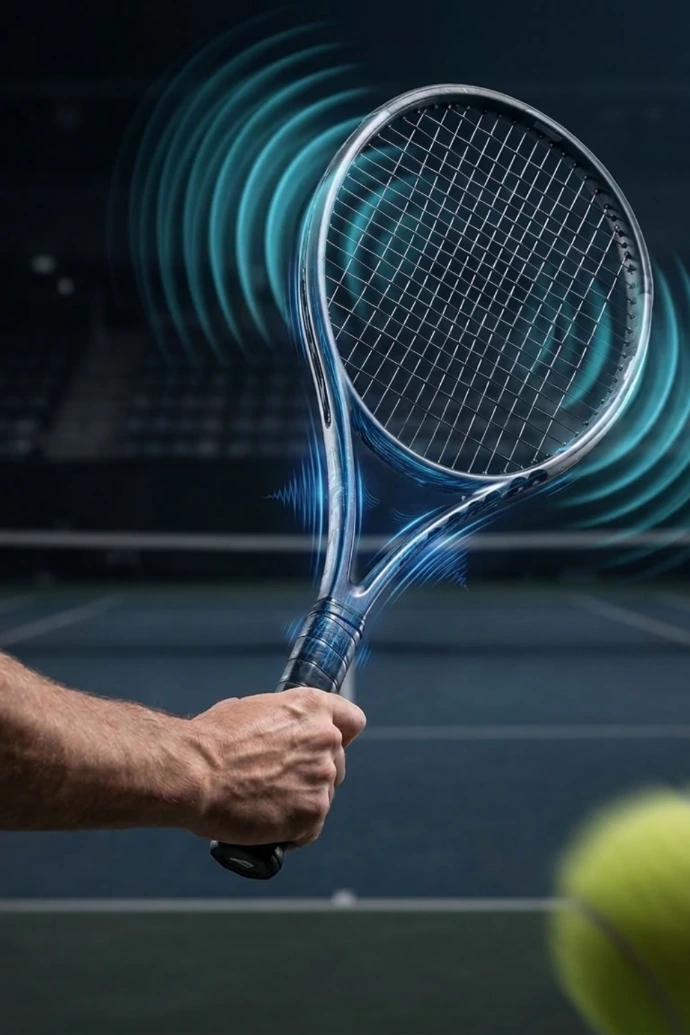
Researchers showed experienced tennis players videos of professional rallies, systematically modifying the volume of the impact sounds while leaving the visual information unchanged.
The result was remarkable: the louder the racket-ball contact sounded, the farther participants expected the ball to travel.
In other words, changing the sound altered the players' perception of the shot, even though its visible trajectory remained the same.
A subsequent study published in 2022 also found that auditory information could influence judgments of ball speed and predicted trajectory.
These findings highlight something important: the sound of impact isn't just background noise. It's part of the information our brains use to interpret tennis.
When Hearing Changes Feeling
Now let's consider what happens when you're the one holding the racket.
Every ball impact generates mechanical vibrations that propagate through the strings, frame and handle. Your hand detects part of this mechanical response, while your ears simultaneously receive the sound produced by the collision.
Together, these signals contribute to what players commonly describe as racket feel.
But here's the catch: perceived vibration isn't determined by mechanical vibration alone.
Research involving AMbelievable™ Universal has explored this relationship by comparing vibration measurements with players' subjective sensations under different listening conditions.
One particularly interesting observation emerged when auditory feedback was masked: participants perceived the vibrations differently, illustrating how the sensation of impact can depend on more than the mechanical signal itself.
This distinction matters because players often associate a sharper sound with a harder impact, or a more muted sound with a softer one. Yet those impressions don't necessarily correspond to equivalent changes in the racket's physical behavior.
And indoors, where reflected sound can alter the acoustic experience of every shot, understanding this relationship becomes especially relevant.
What you hear can influence what you feel. But what you feel doesn't always tell the whole story of what's happening inside your racket.
That raises a practical question: if sound and vibration are different aspects of the same impact, should a tennis dampener simply make the racket quieter?
5. Universal: Controlling Vibrations Without Losing Feel
Traditional tennis dampeners are primarily designed to reduce string vibrations, often producing a noticeably more muted impact sound.
For some players, that's exactly what they're looking for. Others prefer to retain more of the racket's natural response, using the vibrations they feel as part of their feedback on every shot.
But what if vibration control didn't have to mean eliminating those sensations?
That's the principle behind AMbelievable™ Universal, a lightweight, 3D-printed vibration-control device engineered using metamaterial structures.
Unlike conventional dampeners, which mainly act on higher-frequency string vibrations, Universal is designed to attenuate unwanted vibrations selectively across a broader frequency range, including lower-frequency components of the racket's response.
Its internal architecture is engineered to manage vibration through geometry and material behavior, rather than simply relying on additional mass.
The objective isn't to make every impact feel completely silent or disconnected. It's to provide cleaner, more controlled feedback while preserving the sensations that help players feel connected to the ball.
And that's particularly interesting during the indoor season.
When colder conditions and different acoustics can influence your experience of each shot, understanding the difference between sound, vibration and perceived feedback becomes useful when evaluating your equipment.

Because a racket that sounds different isn't necessarily performing differently. And controlling vibration doesn't have to mean sacrificing feel.
Curious to experience the difference? Discover Universal and explore a different approach to racket vibration control.
6. How to Optimize Your Racket Setup for Indoor Tennis
So, should you change your racket setup when the indoor season begins?
Not necessarily. But understanding how your playing environment influences equipment behavior can help you make smarter adjustments instead of relying entirely on sensations.
Here are five things worth considering before your next indoor match.
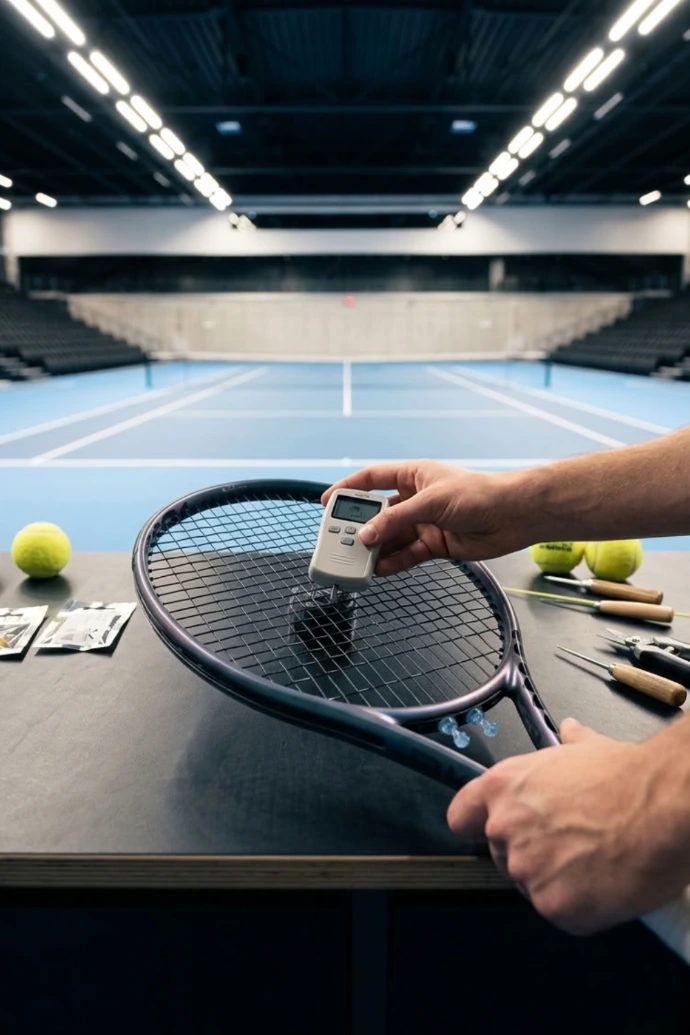
Check the Actual Court Temperature
Indoor doesn't automatically mean warm.
A climate-controlled professional arena and an unheated indoor tennis facility can have very different conditions. Before making adjustments, consider the temperature in which you actually play, rather than simply the season.
If you regularly switch between warm and cold courts, you might notice changes in ball behavior and stringbed response.
The key is consistency: compare your racket's performance under similar conditions before deciding whether something needs to change.
Reconsider Your String Tension, but Don't Rush to Change It
As we've seen, temperature can influence string stiffness, but different materials respond differently.
If your racket consistently feels firmer in colder conditions, experimenting with a slightly lower reference tension could be an option. However, there's no universal adjustment that works for every player or string type.
Before changing anything, consider the age and condition of your strings. Tension loss and material degradation can affect their behavior independently of temperature.
For more insights, read our guide to racket string tension and ball control.
Give Your Equipment Time to Adjust
If you store your racket and tennis balls in a cold environment, avoid assuming they'll immediately behave exactly as they would after reaching the court's temperature.
Balls, strings and racket materials need time to approach the temperature of their surroundings.
This is particularly important for tennis balls, whose internal pressure and rubber properties influence their rebound.
Whenever possible, store your equipment at a reasonably stable temperature and avoid prolonged exposure to extreme cold or heat.
Pay Attention to Both Sound and Sensation
Here's an experiment worth trying during your next indoor session.
Hit a series of shots with your usual racket setup, paying attention to two different aspects of impact:
What you hear: Is the sound sharp, muted, metallic or particularly resonant?
What you feel: Does the impact feel comfortable, firm, controlled or unusually harsh?
Try to evaluate these sensations separately.
Remember that the acoustics of the venue can affect what you hear, while the physical response of your racket contributes to what you feel through your hand.
If you use a dampener, you can also compare a few controlled shots with and without it, ideally using the same balls, court and string setup.
You might discover that changing the sound of impact doesn't necessarily change the other sensations in the way you expected.
Change One Variable at a Time
When a racket doesn't feel right, it's tempting to adjust several things at once: string tension, dampener, grip or even the racket itself.
But from an experimental perspective, that's not the best approach.
If you change multiple variables simultaneously, it becomes difficult to identify which adjustment actually influenced your playing experience.
Instead, try modifying one element at a time and evaluating the result across several sessions.
It's a simple principle borrowed from scientific testing, and one of the most effective ways to understand your personal racket preferences.
Ultimately, the ideal indoor setup isn't necessarily different from your outdoor setup. It's the one that delivers the response, consistency and feedback you prefer under the conditions in which you play.
Conclusion: Indoor Tennis Is a Different Sensory Experience
Moving indoors changes more than the scenery surrounding a tennis court.
Temperature can influence how balls rebound and strings respond, while the acoustics of an enclosed space can change how each impact sounds.
And because our brains combine auditory and tactile information, those differences can also influence the sensations we associate with our shots.
That's what makes racket feel such a fascinating subject: it's not simply a mechanical property of your equipment, but the result of an interaction between physics, environment and human perception.
The next time you step onto an indoor court and notice something different about your racket, pay attention. The explanation might be more interesting than you think.
After all, understanding your equipment is the first step toward making it work the way you want.
Frequently Asked Questions About Indoor Tennis
Does cold weather affect tennis string tension?
Yes. Temperature changes can influence string tension and stiffness, although the effects depend on the string material and construction. A colder stringbed may feel firmer, but that doesn't necessarily mean its tension has increased. String age and playing conditions also contribute to the overall response.
Do tennis balls bounce differently indoors?
They can, but being indoors isn't the direct cause. Ball temperature, internal pressure, rubber properties and court surface all influence rebound behavior. A colder pressurized tennis ball may bounce lower than the same ball at a warmer temperature, even when played on an identical surface.
Are indoor tennis courts faster than outdoor courts?
Not necessarily. Court speed depends primarily on factors such as surface friction and ball-surface interaction, rather than whether the court is covered. Indoor conditions generally eliminate wind and reduce weather-related variability, which can make play feel more predictable without automatically making the surface faster.
Why does my tennis racket sound louder indoors?
Enclosed spaces reflect sound waves from racket-ball impacts. Depending on the court's dimensions, wall materials and acoustic treatment, these reflections can make the impact sound louder, sharper or more resonant. This doesn't necessarily mean the racket is producing more mechanical vibration.
Can a tennis dampener improve racket feel indoors?
A dampener can change the vibration response and sound of the stringbed, potentially influencing how a player perceives impact. However, the result depends on the device and personal preferences. Products such as Universal are designed to selectively control unwanted vibrations while preserving useful feedback, rather than simply muting the sound of every shot.