
Most players think about their tennis racket in simple terms: weight, balance, string pattern, maybe stiffness. But during impact, the frame behaves less like a fixed object and more like a dynamic structure. It bends. It oscillates. It redistributes energy. And all of that happens in a tiny fraction of a second.
That matters more than most players realize.
When people talk about “feel,” they often describe it as if it were something vague or personal. In reality, part of that feeling is mechanical. What reaches your hand after contact is shaped by the way the strings deform, the way the frame flexes, and the way different vibration modes travel through the racket. Some of those vibrations are harmless or even informative. Others are just noise. Some are more closely associated with discomfort in the arm, wrist, or elbow.
This is also why new tennis accessories are starting to move beyond the old logic of “just add weight” or “just mute the sound.”
Devices such as Frame Stabilizer, which is installed in the racket throat and designed to act on harmful frame vibrations through a pendulum-like effect, are based on a more advanced idea: don’t just change the racket’s static specs, change how the frame behaves dynamically at impact.
In practice, the goal is to interact with harmful frame vibrations, especially lower-frequency oscillations associated with arm discomfort, while making the racket’s response feel cleaner and more balanced.
To understand why that matters, we need to start with a simple but powerful idea: your tennis racket is not rigid.

1. What Really Happens When a Tennis Racket Hits the Ball
A tennis shot feels instant, but physically it is a sequence.
First, the ball compresses against the strings. At the same time, the stringbed deforms and stores part of the incoming energy. Then the frame starts responding.
That response is not just a passive consequence of the hit. It is part of the event itself. The frame bends, twists slightly depending on contact location, and begins to vibrate according to its own structural properties.
Even if the contact lasts only a few milliseconds, a lot happens during that time. The racket is not simply “holding” the ball for an instant.
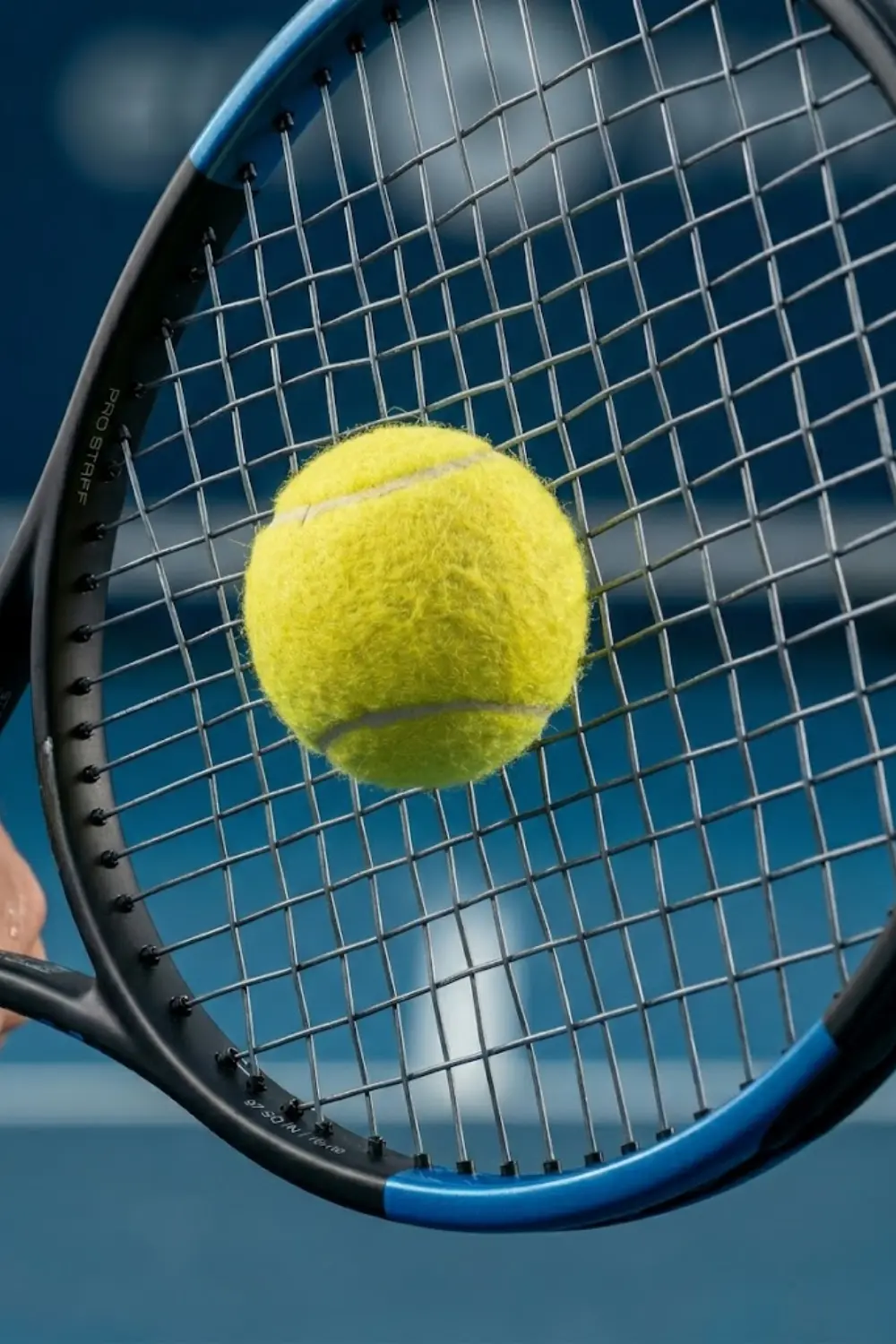
It is participating in a complex energy exchange involving the ball, the strings, the frame, and your arm.
This is one of the biggest reasons why two rackets can have similar published specs and still feel very different on court. Static numbers tell you something useful, but they do not fully describe how the frame behaves when it is actually moving, flexing, and reacting to impact. That dynamic response influences whether the contact feels clean or noisy, stable or shaky, precise or vague.
A player may think they are only feeling the strings. In reality, they are also feeling the frame’s behavior after impact.
2. Why Tennis Racket Flex Is More Important Than Most Players Think
When players hear the word “flex,” they often think of a racket stiffness rating. That is a start, but it is not the full story.
A racket’s stiffness rating is a simplified measurement, usually treated as a broad indicator of how much the frame resists deformation. Useful, yes. Complete, no. Two frames with similar stiffness ratings can still behave differently because flex is not just about how much a racket deforms, but also where, when, and in what pattern it deforms.
A tennis racket can bend along its length, especially through the throat and upper hoop area. It can also respond differently depending on whether contact is centered or off-center. The materials, layup, geometry, and distribution of stiffness across the frame all influence the result.
So when a player says, “These two rackets have the same stiffness, but one feels cleaner,” that is not just subjective noise. It often reflects a real difference in dynamic behavior.
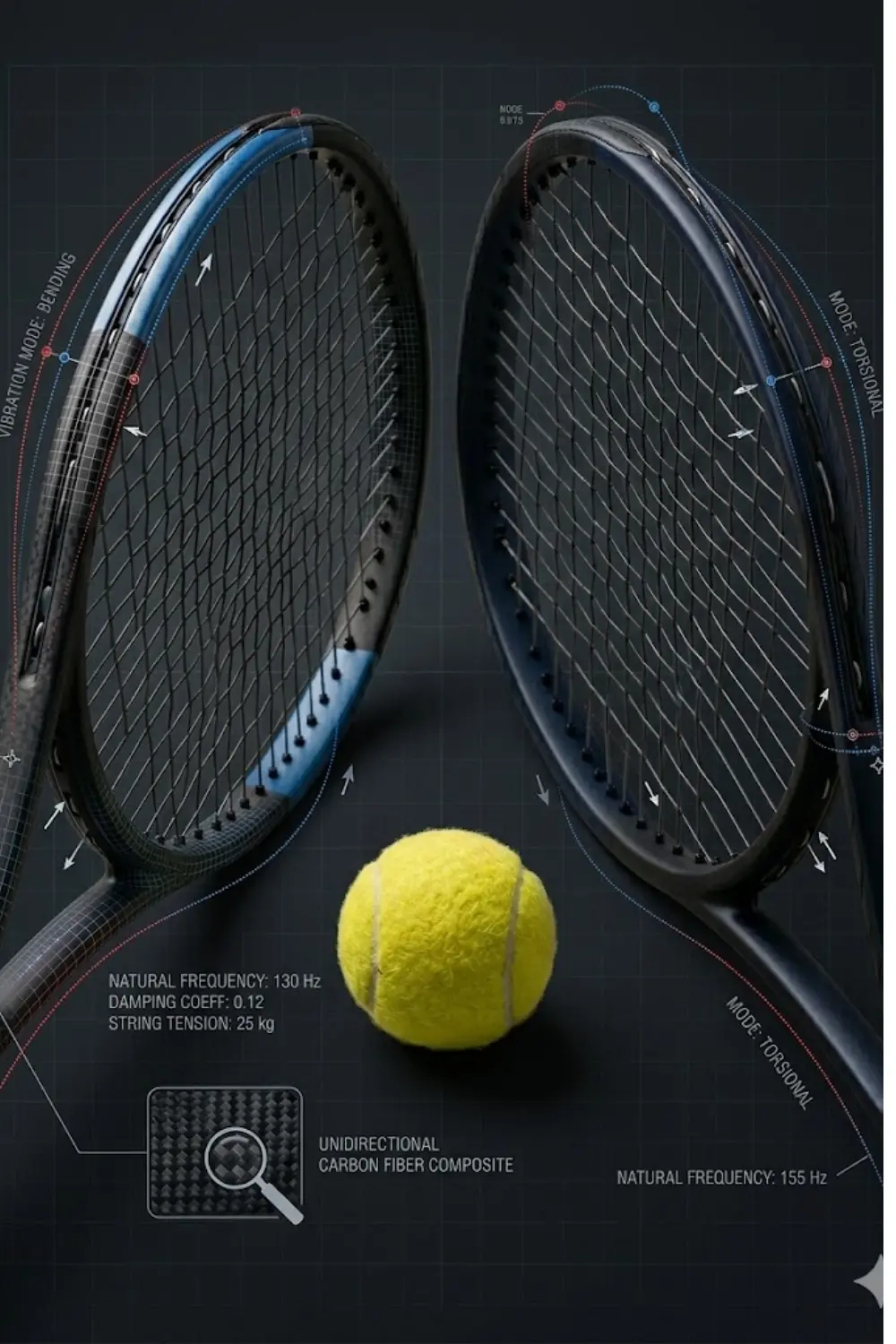
This is why the phrase tennis racket flex should not be reduced to a simple marketing label. Frame bending is part of performance.
A certain amount of flex can contribute to dwell time, feel, and comfort. Too much uncontrolled motion, however, may create instability or unpleasant vibration. Too little can make impact feel overly harsh or “boardy.” The goal is not maximum flex or minimum flex. The goal is a useful kind of structural response.
That is where engineering becomes interesting: not all flex is the same, and not all vibration is bad.
3. The Frame Does Not Vibrate Randomly: Understanding Bending Modes
One of the most useful ways to think about racket behavior is through modes of vibration.
Every physical structure has natural ways of vibrating. If you excite that structure, it does not move randomly. It tends to respond according to recurring shapes and frequencies. These are often called vibration modes, or simply modes.
A tennis racket is no exception.
When the frame is struck, it can vibrate in bending modes, torsional modes, and more complex combinations.
For players, bending modes are especially interesting because they are closely related to how the racket flexes through the throat and hoop, and to how vibration travels toward the hand and arm.
Torsional behavior matters too, especially on off-center shots, but bending is central to understanding why some frames feel smooth and others feel disruptive.

Each mode has two important characteristics: a frequency and a shape. The frequency tells you how fast that mode oscillates. The shape tells you which parts of the structure move more and which parts move less.
This matters because what you feel is not just “vibration” in a generic sense. What you feel is the result of certain frequencies dominating and certain parts of the frame moving in specific ways.
That is also why advanced vibration-control accessories can be more sophisticated than traditional dampening solutions. A standard string dampener mainly acts on the stringbed and is often associated with changes in higher-frequency vibration and sound. By contrast, a device designed for the frame itself can address a different part of the problem. Frame Stabilizer is based on that idea: it is mounted in the throat area and is meant to interact with harmful frame vibrations rather than with stringbed motion, complementing the role of a string dampener rather than replicating it.
In other words, if you want to change how the structure moves, you have to work on the structure.
4. High and Low Frequencies: What You Hear Is Not the Whole Story
Players often notice vibration through sound first.
A racket that sounds sharp, metallic, or noisy is immediately perceived as harsher. A racket that sounds muted or cleaner is often described as more comfortable. But sound is only part of the picture. The frequencies you hear most clearly are not necessarily the same ones that matter most for long-term comfort.
Higher-frequency vibrations are often associated with the acoustic signature of impact and with the immediate “crispness” of the shot. Lower-frequency oscillations, on the other hand, may be felt more deeply through the frame and arm. These are the kinds of vibrations many players describe not as loud, but as tiring, unsettling, or stressful over time.
This distinction is important because many tennis products historically addressed the obvious part of the problem: the audible or superficial part.

But reducing noise is not the same as improving the racket’s full dynamic behavior.
Our product philosophy reflects that distinction. Universal is designed to work across a broader range of vibrations than conventional dampeners, while Frame Stabilizer is built to act on frame oscillations, particularly low-frequency ones associated with arm discomfort. We see the two as complementary, not redundant.
That is a useful framework for players too. If you only think in terms of “more damped” versus “less damped,” you miss a key question: which vibrations are being reduced, and which are being preserved?
Because in tennis, removing everything is not always an upgrade. Sometimes the best setup is the one that keeps the useful information and removes the interference.
5. How Frame Bending Changes Control, Consistency, and Comfort
So what does all of this mean on court?
First, it affects control consistency. If the frame’s response changes the quality of contact from shot to shot, then even very similar swings can produce slightly different outcomes. A racket that feels structurally calmer tends to make impact feel more readable. The player gets clearer feedback, not less.
Second, it affects stability on imperfect contact. Tennis is not played in a lab. Even advanced players hit slightly outside the center all the time.
When the frame responds poorly to those impacts, the result can feel fluttery, harsh, or imprecise. When the dynamic response is better controlled, the racket can feel more composed even when contact is not perfect.
Third, it affects comfort, especially over time. Arm discomfort is rarely about one single impact. It is about repetition.

If certain frame vibrations keep traveling into the hand, wrist, forearm, and elbow over long sessions, the cumulative effect matters.
That is exactly why we developed Frame Stabilizer to help control harmful frame vibrations often associated with arm discomfort, including the kind of low-frequency motion many players perceive as more stressful over time. At the same time, it is important to be clear: it is not a cure for injury, but a tool designed to reduce strain during play.
This is an important distinction. Equipment does not replace technique, strength, recovery, or medical care. But it can influence the mechanical load your body experiences every time you hit the ball.
And if you hit thousands of balls, small differences are not small anymore.
6. Frame Stabilizer: A Different Way to Think About Tennis Racket Vibration
Most tennis players are familiar with accessories that act on strings or add mass to the frame. Frame Stabilizer belongs to a different category.
We designed it to be installed in the racket throat, where it works as a pendulum system. The idea is not simply to deaden everything or to change the racket through large weight additions.
Instead, it is meant to move in opposition to the frame’s natural oscillation, helping stabilize the racket and reduce harmful frame vibrations, especially those associated with low-frequency motion and arm discomfort.
Our goal with Frame Stabilizer is to offer players more stability, more precision, and a cleaner, more consistent feel.
That logic is interesting because it fits the physics of the problem.
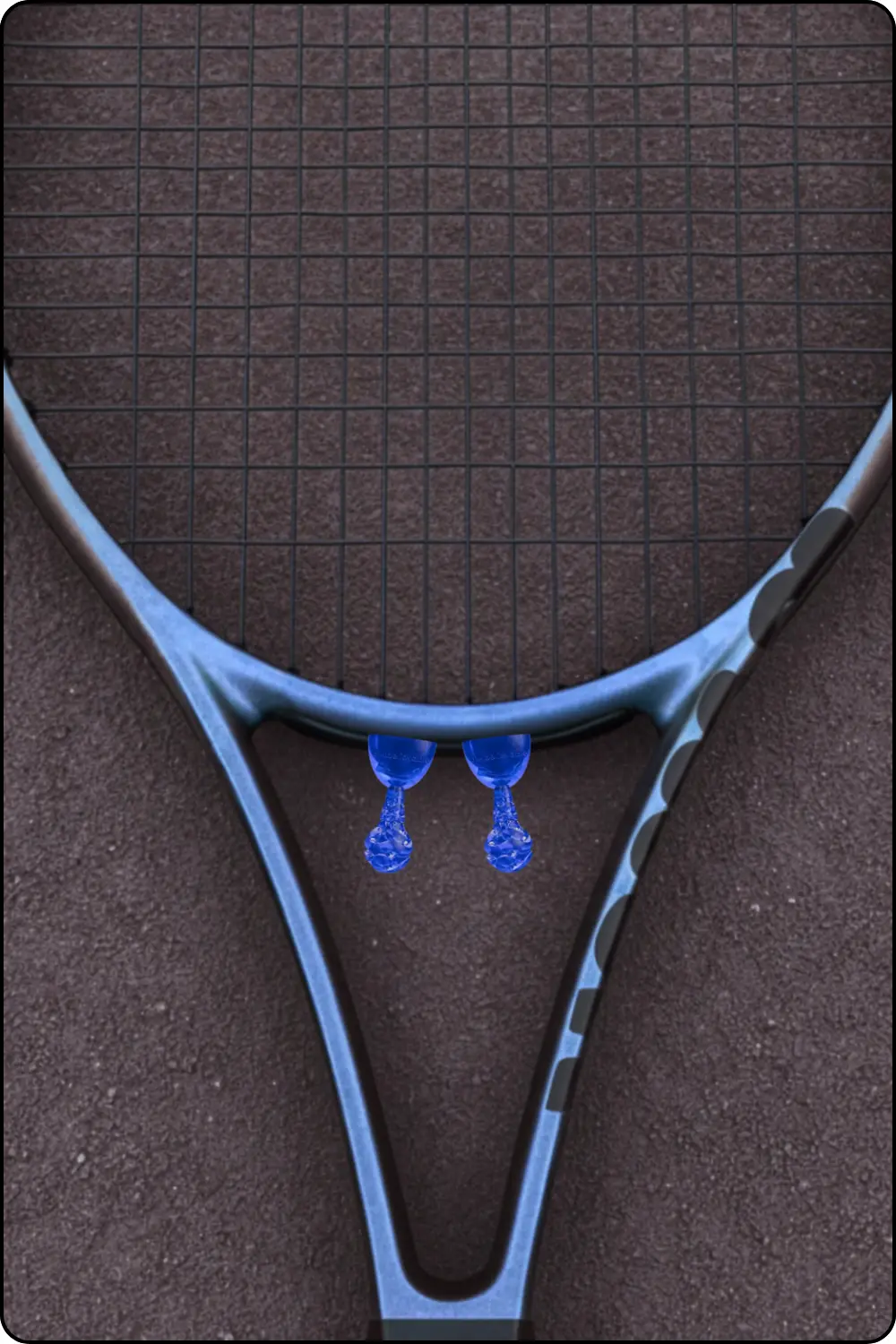
If the frame bends according to specific modes, then a well-designed accessory can aim to influence those modes rather than just changing the sound of the shot. In that sense, Frame Stabilizer is not about muting the racket. It is about reshaping how the frame moves after impact.
That is also why the throat location matters. The throat is structurally relevant in the bending behavior of the frame. Working there is a different engineering choice than placing something on the strings. We created Frame Stabilizer to act where traditional string dampeners do not, in a complementary way rather than as a simple replacement.
For the player, that translates into a practical promise: a more balanced response, cleaner feel, and less disruptive vibration without necessarily losing natural shot feedback. And that is a much more modern idea than the old “just make the racket quieter” approach.
7. Why Small Accessories Can Change More Than Players Expect
There is still a common belief in tennis that meaningful equipment change must come from changing the racket itself. New frame, new strings, new tension, new result.
Sometimes that is true. But not always.
The problem with that mindset is that it treats performance as if it lived only in the big visible components. In reality, performance also depends on the dynamic interaction between those components. A small accessory can matter if it changes the right part of the system.
That is especially true in a sport governed by short contact times, repeated impacts, and mechanical sensitivity.
A tiny change in how the frame bends or how vibration propagates can alter feel, consistency, and comfort far more than its size suggests.
This is exactly the space where we want to contribute something different: not by simply adding accessories, but by engineering racket behavior.
Our broader product ecosystem reflects that philosophy, with solutions designed to act on stringbed vibration, frame vibration, and torsional behavior across different parts of the racket.
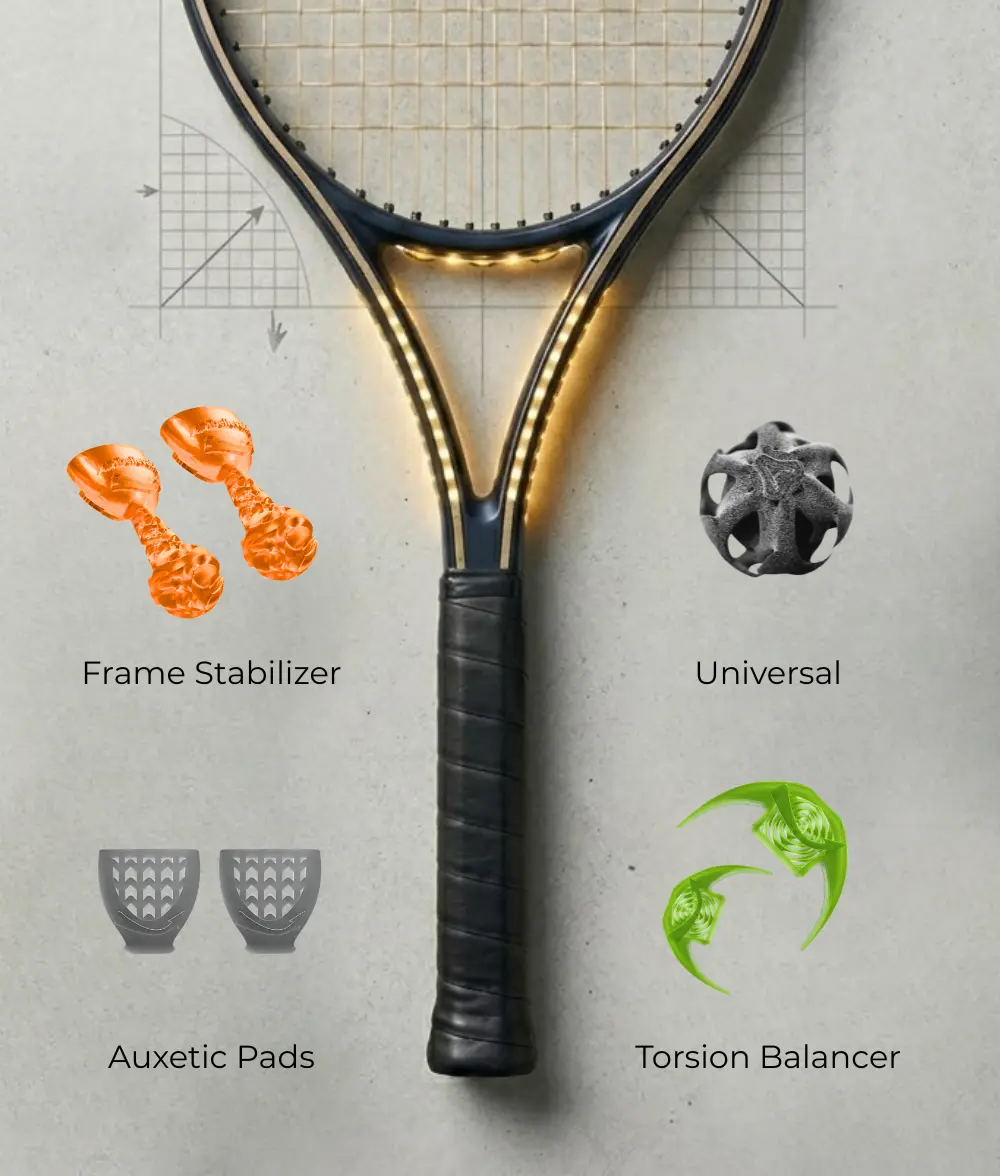
That makes sense strategically too. Innovation in tennis often focuses on rackets and strings, while accessory design remains surprisingly conservative. But for players, the real question is not which category a product belongs to. It is whether it improves the way the racket behaves in motion and at impact.
If it does, then it is no longer a minor detail.
8. How to Notice Better Frame Behavior on Court
If you want to feel racket flex and frame behavior more clearly, do not focus only on power.
Pay attention to the quality of contact. Does the racket feel cleaner or more chaotic? On off-center shots, does the frame stay composed or does it feel like the hit breaks apart? After a long session, does your arm feel calm, or slightly beaten up even when your technique felt fine? These are often better indicators than one spectacular shot.
A useful test is to compare two setups during a normal session and look for patterns rather than isolated impressions. Notice how the racket behaves on routine rally balls, defensive contacts, blocked returns, and slightly late shots.
The moments when you are not perfect often reveal the most about how the frame is really behaving. Because the best setup is not always the one that feels dramatic. Often, it is the one that feels quietly more reliable.

Conclusion
A tennis racket does not simply hold the strings together. It is a dynamic structure that bends, vibrates, stores energy, and sends information back to your hand every time you hit the ball.
Understanding tennis racket flex means understanding that frame behavior is part of performance, not a side effect. The way the racket bends affects feel. The way it vibrates affects comfort. The way those motions are controlled affects consistency.
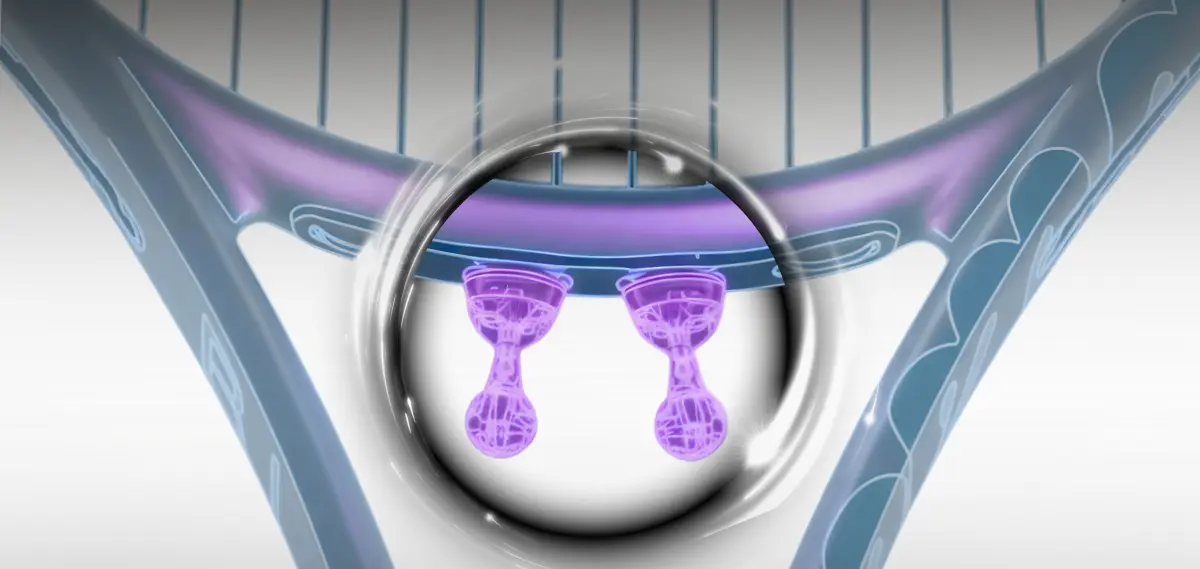
That is why frame-focused solutions deserve more attention than they usually get. Products such as Frame Stabilizer point toward a smarter approach to equipment: not just adding mass, not just muting sound, but shaping the racket’s dynamic response where it matters. On AMbelievable’s site, that means a throat-mounted pendulum system designed to control harmful frame vibrations, improve stability and precision, and complement string-based dampening rather than duplicate it.
The takeaway is simple: you do not just hit the ball with a racket. You interact with a structure that moves, bends, and reacts for you. And the better that structure behaves, the better your tennis can feel.