
You hit the ball slightly outside the sweet spot. The contact feels different. The racquet head rotates in your hand, the shot flies longer than expected, and the feedback is less clean than usual.
Most players describe this as a “mishit.” What they rarely consider is what actually happens to the frame in that fraction of a second.
When contact occurs away from the geometric center of the string bed, the racquet does not simply vibrate — it twists.
This rotational motion, known as racquet torsion, is a structural response to off-center impact, and it plays a decisive role in directional control, energy transfer, and perceived stability.
Many players ask the same question: Why do I lose control on mishits? The answer is not only about technique or timing. It is also about physics.
At AMbelievable™, we developed the Torsion Balancer specifically to address this phenomenon.

Using a 3D-printed metamaterial geometry, it is designed to interact with torsional instability while preserving the natural feel of impact. But before discussing solutions, it is essential to understand the mechanism.
In this article, we will examine what really happens when you hit outside the sweet spot, why the racquet twists, and how torsion directly influences precision on court.
1. What Happens When You Hit Outside the Sweet Spot?
The sweet spot is often described as a single point on the string bed where impact feels clean and powerful. In reality, it is a dynamic zone influenced by the frame’s geometry, mass distribution, and vibration nodes. Even so, it remains limited in size.
When the ball strikes the strings away from this optimal region, the force is no longer aligned with the racquet’s longitudinal axis. Instead of traveling symmetrically through the frame, the impact force is applied at a distance from the center of rotation.

From a mechanical perspective, this creates torque. Torque is generated whenever a force acts at a distance from an axis, and in the case of a tennis racquet, that axis runs along the length of the frame.
The greater the distance between the impact point and the central axis, the greater the rotational tendency.
This is why the racquet head twists during a mishit. The frame attempts to rotate around its longitudinal axis as it absorbs and redistributes the impact force.
The player perceives this as instability, but mechanically it is a predictable structural response.
Importantly, this phenomenon is different from simple string vibration. Vibrations are oscillatory movements that occur after impact, often at higher frequencies. Torsion, instead, is an immediate rotational deformation caused by asymmetric loading.
In other words, when you hit outside the sweet spot, your racquet does not just vibrate — it twists. And that twist is the starting point of reduced precision.
2. What Is Racquet Torsion?
Racquet torsion is the rotational deformation of the frame around its longitudinal axis following an off-center impact. It is a structural response, not a subjective sensation, and it occurs within milliseconds after the ball contacts the strings.
To understand it clearly, it is helpful to distinguish torsion from other types of racquet movement. When the ball hits the string bed, several mechanical events happen at the same time.
The strings deflect and vibrate. The frame bends slightly along its length. And if the impact is not centered, the racquet also rotates around its long axis.
This rotational movement is torsion.
Unlike string vibration, which mainly affects sound and high-frequency feedback, torsion changes the angular orientation of the string bed during impact.
That small rotation influences how the ball leaves the racquet face.
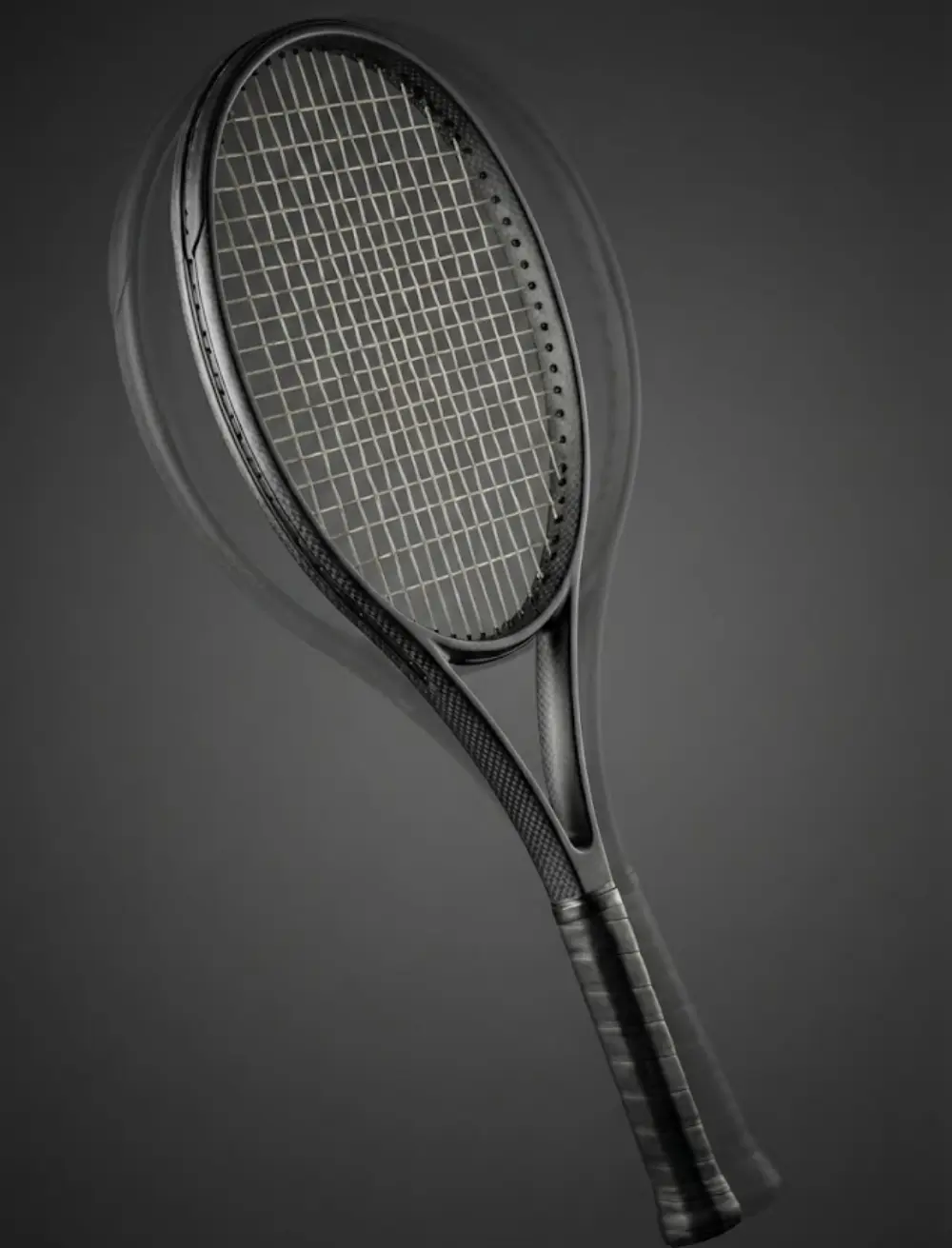
The degree of torsion depends on multiple factors, including impact location, racquet geometry, mass distribution, and polar moment of inertia. Frames with lower resistance to twisting will rotate more when the ball strikes away from the center. Frames with higher torsional stability resist that rotation more effectively.
It is important to emphasize that torsion is not inherently a defect. It is a natural mechanical consequence of asymmetric loading. The problem arises when that rotational response becomes large enough to influence precision, energy transfer, and stability during play.
Understanding torsion means understanding that mishits are not only about missing the sweet spot. They are about how the frame reacts when that happens.
3. Why Torsion Reduces Precision
Precision in tennis depends largely on the stability of the string bed at the exact moment the ball leaves the racquet. Even small variations in racquet face angle can significantly alter the trajectory of the shot.
When torsion occurs, the frame rotates slightly during impact. That rotation changes the orientation of the string bed relative to the incoming ball. Although the angular variation may appear minimal, the effect on ball direction can be substantial, especially at higher swing speeds.
This is one of the main reasons players lose control on mishits. If the racquet face opens or closes by just a small fraction of a degree due to torsional rotation, the ball’s launch angle shifts accordingly.
Over the length of the court, that small change can translate into shots landing long, wide, or shorter than intended.
There is also an energy component. When part of the impact force is redirected into rotational motion, less energy is transferred efficiently into forward ball propulsion.
The result is often a combination of reduced power consistency and altered depth control.
In practical terms, torsion affects both direction and predictability. The player may feel that the contact was unstable, but the underlying issue is mechanical. The racquet rotated under asymmetric load, and that rotation modified the outcome of the shot.
This is why control on off-center hits is not purely a matter of technique. It is also a matter of how much torsional stability the frame can provide during impact.
4. How Often Do Off-Center Hits Really Happen?
Many players assume that off-center hits are rare and mostly limited to beginners. In reality, they are a structural part of modern tennis.
The pace of today’s game, the heavy use of topspin, and the constant pressure on timing make perfectly centered contact less frequent than most players believe. Even advanced players regularly strike the ball slightly above, below, or to the side of the geometric center of the string bed.
Consider a few common situations. A wide forehand played on the run rarely allows ideal spacing. A defensive backhand stretched outside the body line often leads to contact closer to the frame edge.
Returns of serve, especially against high pace, frequently result in impact outside the central zone. High contact points above shoulder height can also shift the effective sweet spot.
Fatigue further increases this effect. As a match progresses, footwork precision decreases slightly, reaction time slows, and preparation becomes less optimal.
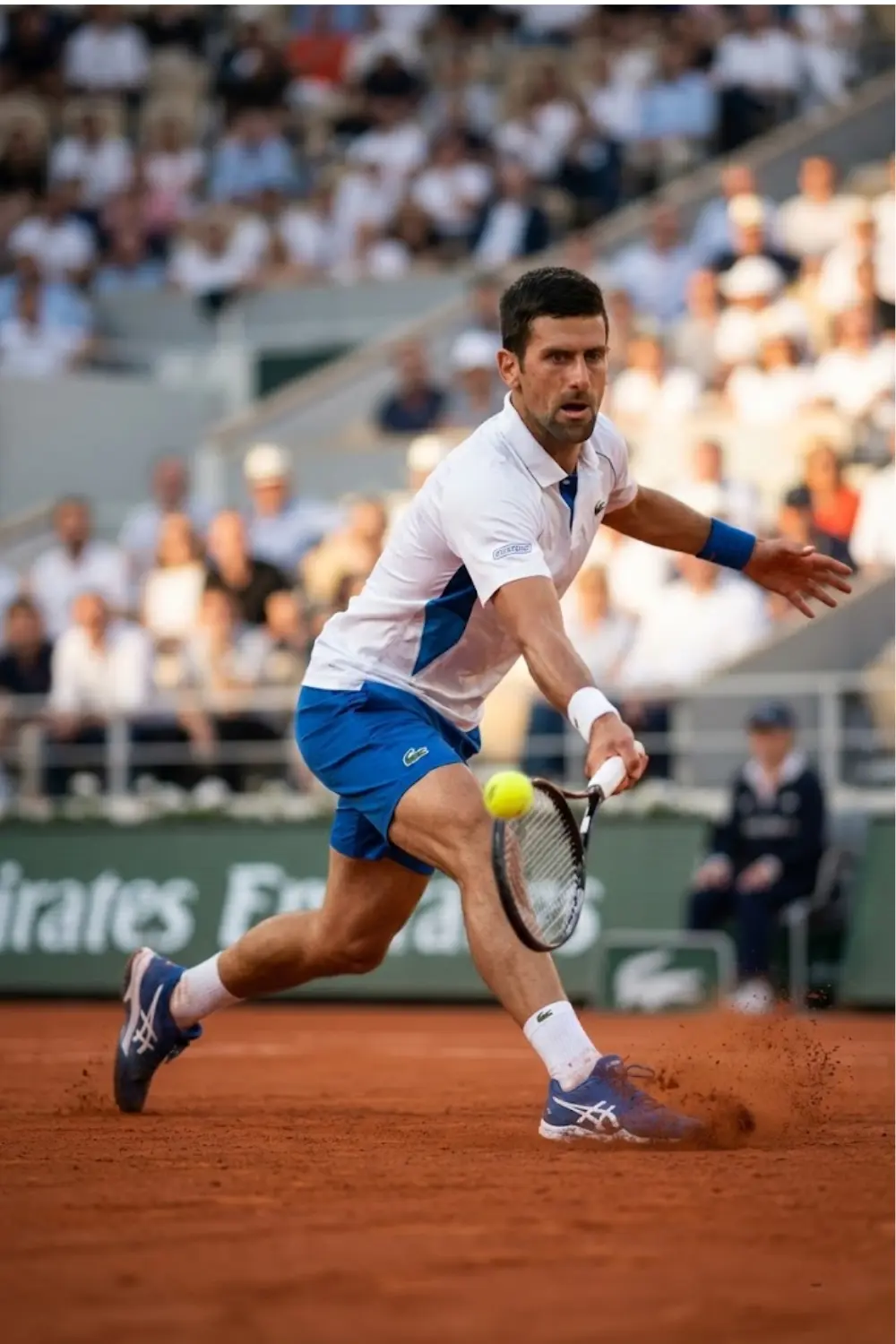
These small changes make off-axis impact more likely. The player may not perceive it clearly, but the frame does.
From a mechanical perspective, this means torsional stress is not an occasional anomaly. It is repeatedly generated throughout a match. The question is not whether torsion occurs, but how much the racquet resists it. Understanding how common off-center hits are changes the perspective. Torsional stability is not only about mishits in extreme situations. It is about maintaining control in the many slightly imperfect contacts that define real match play.
5. Traditional Ways to Reduce Torsion and Their Limits
Players and technicians have long tried to increase torsional stability through mass redistribution. The most common method is adding weight at the 3 and 9 o’clock positions on the frame. By increasing mass farther from the central axis, the racquet’s resistance to twisting increases.
This approach works because it raises the polar moment of inertia. A higher resistance to rotation means that, for the same off-center impact, the frame will twist less. The string bed remains more stable, and directional consistency improves. However, this solution comes with trade-offs.

Adding mass increases overall swingweight. The racquet becomes more stable, but also less maneuverable. Reaction speed can decrease, especially at net or during rapid exchanges. Over longer matches, additional weight can also contribute to arm fatigue.
Heavier frames or thicker beam constructions follow a similar logic.
They increase structural rigidity and torsional resistance, but they alter the overall playing characteristics of the racquet.
These modifications are global rather than selective. They affect the entire response of the frame, not only its torsional behavior during off-center impact.
For players seeking stability without sacrificing maneuverability or feel, purely mass-based solutions may not always represent the most refined option.
This opens the door to a different question. Instead of increasing weight to fight torsion, is it possible to interact with torsional instability in a more targeted and efficient way?
6. A Selective Approach to Torsional Stability
If traditional methods rely primarily on increasing mass and inertia, a more refined approach focuses on interacting directly with torsional behavior rather than simply resisting it with additional weight.
This is the engineering principle behind the Torsion Balancer.
Instead of modifying the entire racquet’s mass distribution, the Torsion Balancer uses a 3D-printed metamaterial geometry designed to respond to torsional deformation. Its structure is not passive weight, but functional geometry. The internal design is developed to interact with rotational instability generated by off-center impact.
Because it adds minimal mass, it does not significantly alter swingweight or overall maneuverability. At the same time, it contributes to reducing the amplitude of torsional rotation when asymmetric loading occurs.
The objective is not to eliminate movement entirely. A racquet must retain a certain degree of responsiveness to preserve feel and feedback.
The goal is to limit excessive twisting that alters string bed orientation and compromises directional consistency.
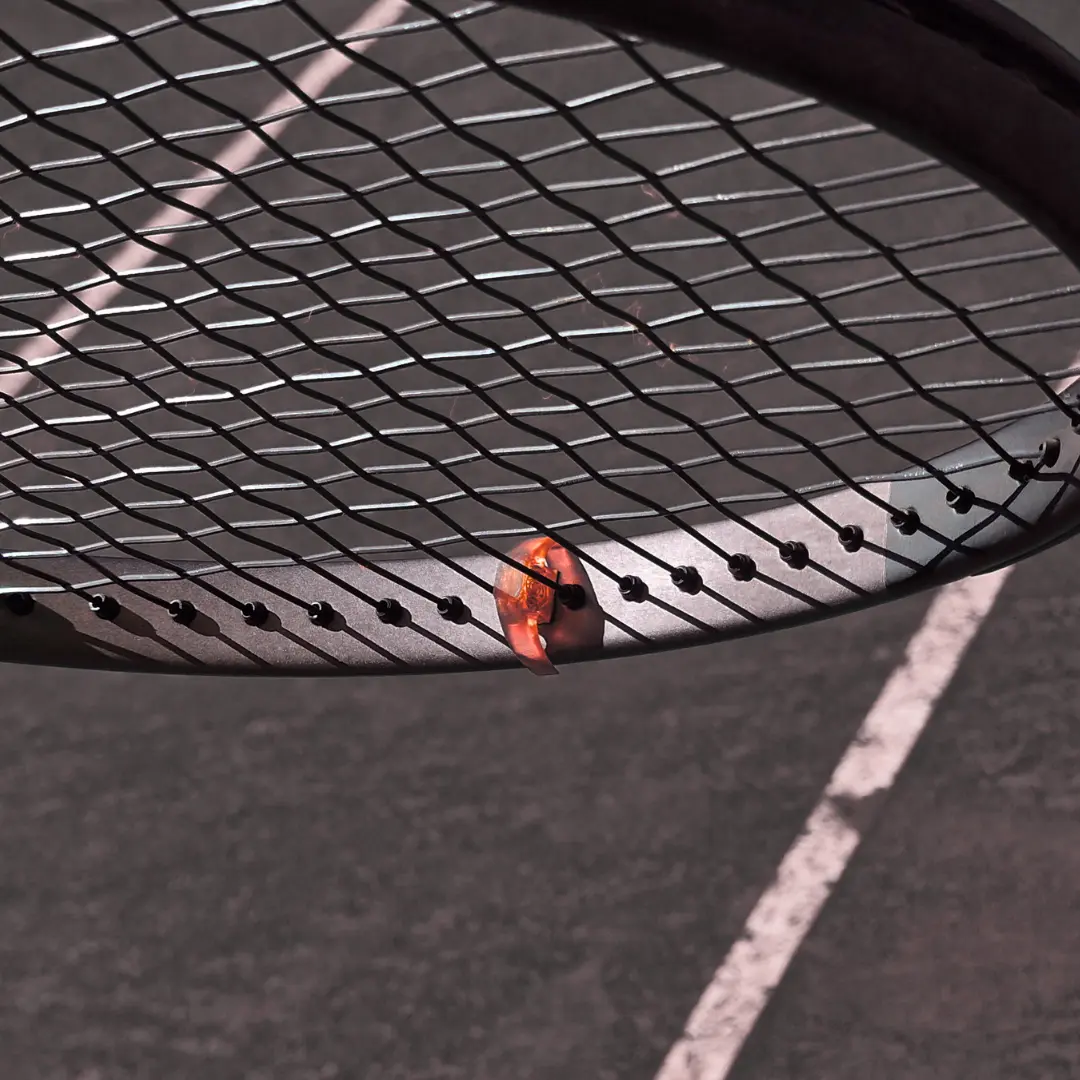
By addressing torsion more selectively, stability can be improved without globally changing the character of the frame.
7. Torsion, Fatigue, and Match Performance
Torsional stability becomes even more relevant as physical fatigue increases.
During the early stages of a match, players can compensate for small instabilities with grip strength and precise timing. As rallies accumulate and muscular fatigue sets in, the ability to actively stabilize the racquet decreases.
When this happens, off-center impacts tend to increase. At the same time, the forearm must work harder to counter unwanted rotational forces.
The combination of slightly less accurate contact and reduced muscular control amplifies the effect of torsion.
This is often the phase where control seems to decline. Shots that felt solid earlier in the match begin to feel less predictable.
Depth control becomes inconsistent. Directional precision narrows.

In this context, torsional stability is not just about isolated mishits. It becomes a factor in maintaining performance consistency over time. A frame that better manages rotational instability can help preserve control when physical compensation is less effective.
In competitive play, small margins decide points. Stability under imperfect conditions can therefore represent a tangible advantage.
8. Conclusion
Racquet torsion is a structural rotation that occurs when the ball strikes outside the sweet spot. It is not simply a matter of feel or sound, but a mechanical response to asymmetric loading.
Off-center hits are more common than most players assume, especially in modern, high-paced tennis and during physically demanding exchanges.
Each of these impacts generates torque, which can cause the frame to twist around its longitudinal axis.
This rotation influences string bed orientation at the moment of ball release.
Even small angular deviations can alter trajectory, depth, and directional accuracy. In this way, torsion directly contributes to reduced precision on mishits.

Traditional solutions increase torsional resistance by adding mass. While effective, they often modify the entire behavior of the racquet. A more selective approach focuses on interacting with torsional deformation itself, aiming to improve stability without sacrificing maneuverability or feel.
Understanding torsion allows players to move beyond the generic concept of a mishit. It reveals that control is not only about technique, but also about how the frame reacts under real playing conditions.
When you know why your racquet twists, you can make more informed decisions about how to control it.